

Alsace
 4
5.6
4
5.6

- proper noun
- /ælˈsɑs/
- Oh, I just remember my little village in Alsace.
- Alsace-Lorraine
- Alsace-Moselle
- Alsace, France
Loading YouTube…
Watch on YouTubeThere was indeed a lot of mistrust from German high command towards soldiers and civilians from Alsace and Lorraine.
- There was indeed a lot of mistrust from German high command towards soldiers and civilians from Alsace and Lorraine.
Examples
-
The wine produced in Alsace is known for its distinct flavors and quality.
-
In fact, Alsace has been part of Germany since 1870.
-
She's across the border in Alsace.
-
I've never been to Alsace.
-
Religions, including the clergy's salaries, are state-funded in Alsace and Moselle.
Academic text (2006) -
Hans Bethe was born on 2 July 1906 in Strasbourg, when Alsace was part of the Wilhelminian Empire.
Academic text (2005) -
The eastern part of France consists of the Alsace, Lorraine, Franche-Comté, and Burgundy regions.
Blog text (24) -
One fourth grader traced the family's tree back to seventeenth-century Alsace Lorraine on one side and to Puritan Yorkshire on the other.
Academic text (1991) -
During our vacation, we visited charming villages in Alsace and enjoyed the local cuisine.
-
I learned about the rich history of Alsace, a region where French and German cultures blend beautifully.
Synonyms
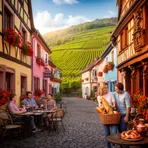
A region in northeastern France that has villages, vineyards, and a mix of French and German culture
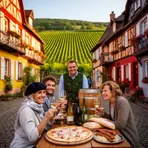
A region in northeast France famous for wine and mixed French and German culture
Surface Forms
Etymology
Alsace comes from the old German name Elsass, which originally meant something like 'land by the river' because people settled along the region's rivers. So it helps to remember Alsace as the border area where French and German ways of life meet.