
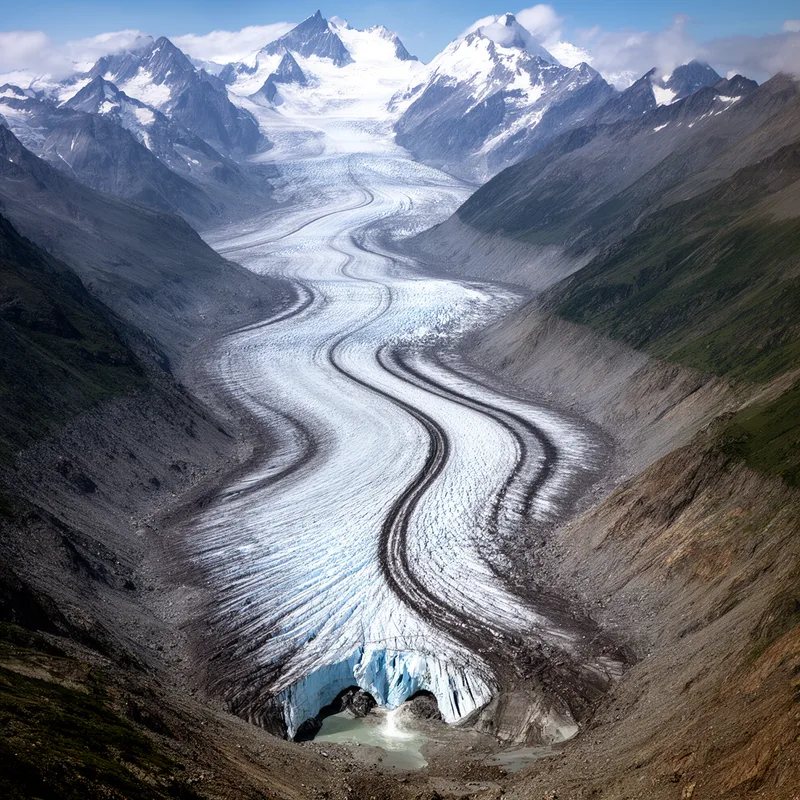
Alpine glacier
- noun
- /ˈælpaɪn ˈɡleɪʃər/
- Tourists flock to see the stunning views of the Alpine glacier that reflects the sunlight beautifully.
Examples
-
Exactly the same reasoning had been employed by Murchison, from the lack of sufficiently high mountain ranges in the United Kingdom, to have allowed for the creation of Alpine glaciers descending from their summits.
Academic text (2018) -
The Alpine glacier slowly carved out the valley as it moved toward the lower elevations.
-
Hitchcock then summarily rejected the inference on logical grounds that such Alpine glaciers could ever have radiated down their slopes.
Academic text (2018) -
Surprisingly, however, the alpine glaciers of the dry valleys seem to have maintained their position within a few hundred meters for the past 3.5 million years (Hall et al. 1993, Wilch et al. 1993).
Academic text (1999) -
Other relict channels may have lost their water source after the retreat of alpine glaciers, which now feed new stream channels, or they may have been cut off from meltwater by upstream sediment deposition that formed a barrier to flow.
Academic text (1999) -
As climate change progresses, many scientists study how Alpine glaciers are retreating at an alarming rate.
How Large


Surface Forms
Morphology
The meaning is directly and transparently derived from combining 'alpine' (relating to high mountains) with 'glacier' (a slowly moving mass of ice); an average B1 learner who knows both words can infer a glacier in mountainous regions. This adjective+noun composition follows a common and cross-linguistically familiar pattern, so the sense is immediately comprehensible without prior exposure.
Etymology
Alpine glacier comes from two parts: Alpine meaning 'from high mountains' and glacier meaning 'a large slow river of ice'. The image is of ice high in the mountains slowly moving down a valley, so the phrase now means 'a glacier in the mountains that moves down a valley'.