
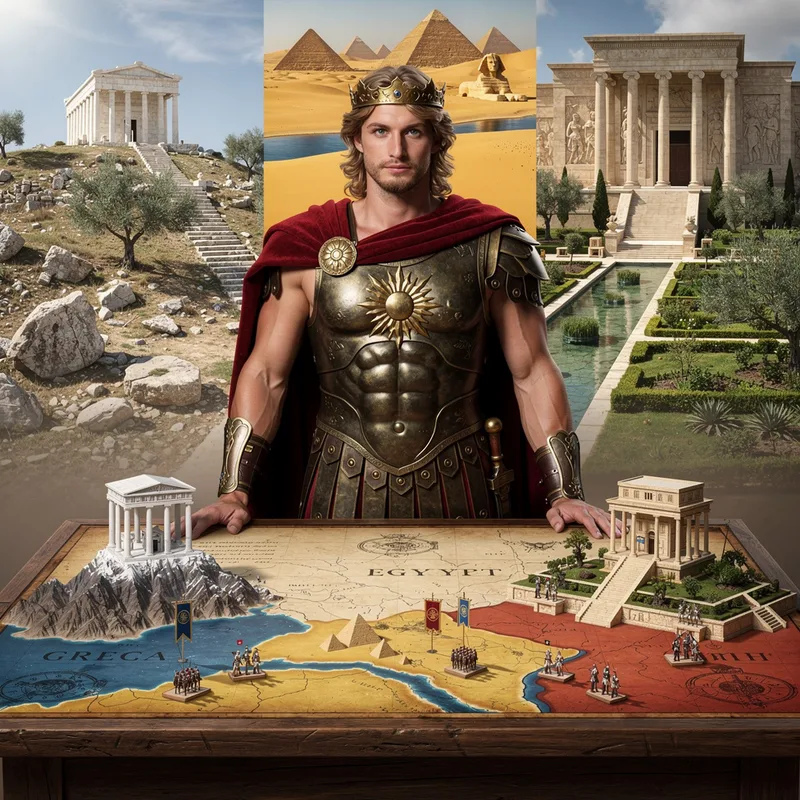
Alexander the Great
 4
4.9
4
4.9

- proper noun
- /ˌælɪɡˈzændər ðə ɡreɪt/
- In the late fourth century BC, the Macedonian ruler Alexander the Great conquered the vast Persian empire and in 326 BC brought Greek rule as far as the Indus territories.
- city founded by Alexander the Great
Loading YouTube…
Watch on YouTubeAristotle became the mentor of Alexander the Great.
- Aristotle became the mentor of Alexander the Great.
- But when Alexander the Great was asked, to whom do you owe your life?
Examples
-
Greece: In a cemetery at Pella, birthplace of Alexander the Great, archaeologists found gold jewelry and weapons dating from the 7th to the 3rd century B.C.
Academic text (2009) -
"We are not a big country now, but we were a great country thanks to Alexander the Great," he says.
Academic text (2009) -
But when Alexander the Great was asked, to whom do you owe your life?
-
Once the classical world's dominant port, by the early 19th century, the city founded by Alexander the Great was seemingly in terminal decline.
Academic text (2010) -
The Afghans will wait out this latest incursion as they did those by every foreign invader since Alexander the Great.
Academic text (2011) -
Two centuries later, these were important prizes for Alexander the Great, whereas the chronicles of the general's campaigns in the region in 332 B.C. do not even mention Beirut.
Academic text (2011) -
Many historians study the life and conquests of Alexander the Great to understand ancient warfare.
-
The city of Alexandria, founded by Alexander the Great, became a center of learning and culture.
-
His military campaigns across Persia were led by Alexander the Great, who is often considered one of history's greatest commanders.
Synonyms
 ∞
5.5
∞
5.5
A king of Macedonia who conquered Greece, Egypt, and Persia and founded the city of Alexandria
Surface Forms
Morphology
The phrase is partly transparent because a learner who knows 'Alexander' as a personal name and 'the great' as an epithet meaning 'distinguished' can infer that this refers to a famous or outstanding Alexander. However, identifying the specific historical figure (King of Macedon, conqueror and founder of Alexandria) and the full biographical meaning requires world-knowledge beyond the constituent words, so it is not fully predictable from composition alone.
Etymology
Alexander the Great comes from the real king Alexander of Macedon who, as a young leader, rode with his army across many lands and won a huge empire. Because he conquered so much and founded cities like Alexandria, people called him 'the Great', meaning 'very powerful and famous', and that is why we use the name today.