
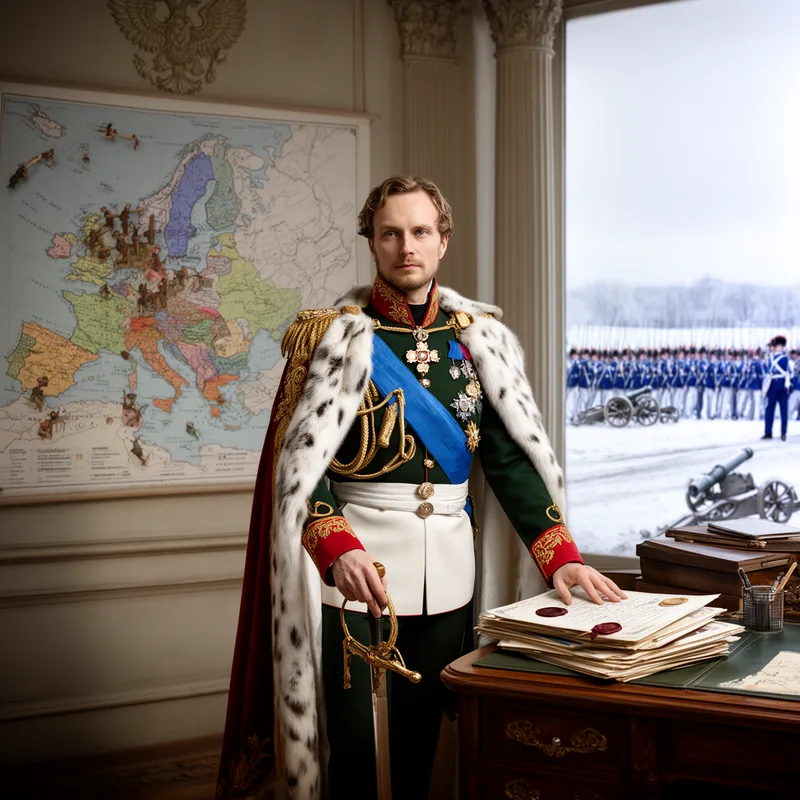
Alexander I


 1
7.5
- proper noun
- Historians debate the motives behind Alexander I's foreign policy decisions.
Examples
-
Emperor Alexander I introduced significant reforms in Russia.
-
Alexander I ruled Russia during a time of great upheaval and conflict with Napoleon.
-
The reforms introduced by Alexander I were considered progressive for his era.
-
Did Alexander I lead Russia during the Napoleonic Wars?
-
During his reign from 1801 to 1825, Alexander I implemented several liberal reforms.
-
Known for his role in the Napoleonic Wars, Alexander I was a significant figure in Russian history.
-
In 1812, Alexander I made crucial decisions that shaped Russia's defense strategy against Napoleon.
Synonyms
 1
8.9
The emperor of Russia from 1801 to 1825 who helped defeat Napoleon and tried to make changes
 1
8.6
A Russian emperor from 1801 to 1825 who tried to make changes and helped defeat Napoleon
Surface Forms
Morphology
Alexander + I
The form 'Alexander I' is compositionally predictable as 'Alexander the First' (name + ordinal), so the ordinal relation is transparent to learners who recognize 'I' as 'first'. However, the specific historical identity and role (Emperor of Russia, dates and reforms) are encyclopedic and cannot be derived from the constituents, so full meaning requires background knowledge.
Etymology
Alexander I was the Emperor of Russia from 1801 to 1825. He tried some 'reforms' at home and led Russia against Napoleon, so think of Alexander I as the ruler who wanted change but had to face a great foreign threat.