
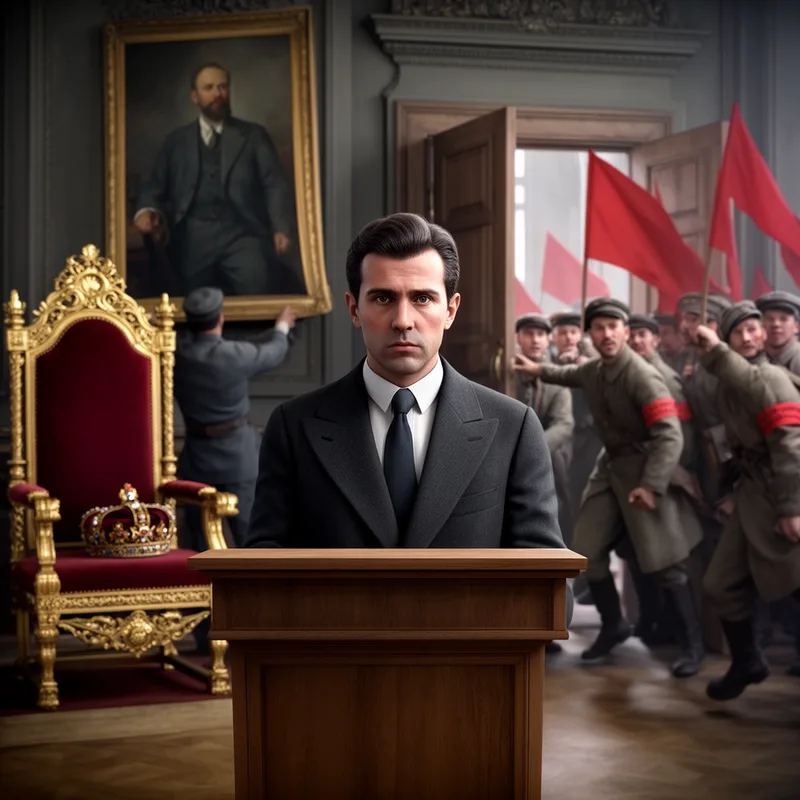
Aleksandr Feodorovich Kerensky
- proper noun
- Aleksandr Feodorovich Kerensky played a key role in the Russian Revolution of 1917 before being deposed by the Bolsheviks.
Examples
-
Many historians debate whether Aleksandr Feodorovich Kerensky could have prevented the rise of the Soviet regime.
-
After his exile, Aleksandr Feodorovich Kerensky lived in several countries and became a lecturer and writer.
-
Aleksandr Feodorovich Kerensky was a revolutionary leader.
-
Did Aleksandr Feodorovich Kerensky really believe in democracy?
-
Aleksandr Feodorovich Kerensky served as the Prime Minister of Russia during the pivotal days of the October Revolution.
-
Aleksandr Feodorovich Kerensky sought to establish a democratic government after the fall of the Tsar.
-
Aleksandr Feodorovich Kerensky is often remembered for his efforts to lead Russia through a transitional period of upheaval.
Synonyms
 1
9.1

A Russian political leader who led the temporary government in 1917
Surface Forms
Morphology
Aleksandr + Feodorovich + Kerensky
This item is a full personal name (proper noun) whose meaning is referential (identifies a specific historical person) rather than compositional; the constituent tokens are themselves names or not lexically informative. Knowing the parts 'Aleksandr', 'Feodorovich' and 'Kerensky' does not allow a B1 learner to infer the biographical meaning (revolutionary leader/head of state), so the expression is not semantically derivable from its parts.
Etymology
Aleksandr Feodorovich Kerensky was a Russian politician who led the country for a short time in 1917 after Nicholas II left power. Think of him as a leader trying to hold the nation together in a storm: he was a temporary 'head of state' who was soon 'overthrown' by the Bolsheviks, which is why he is remembered today.