
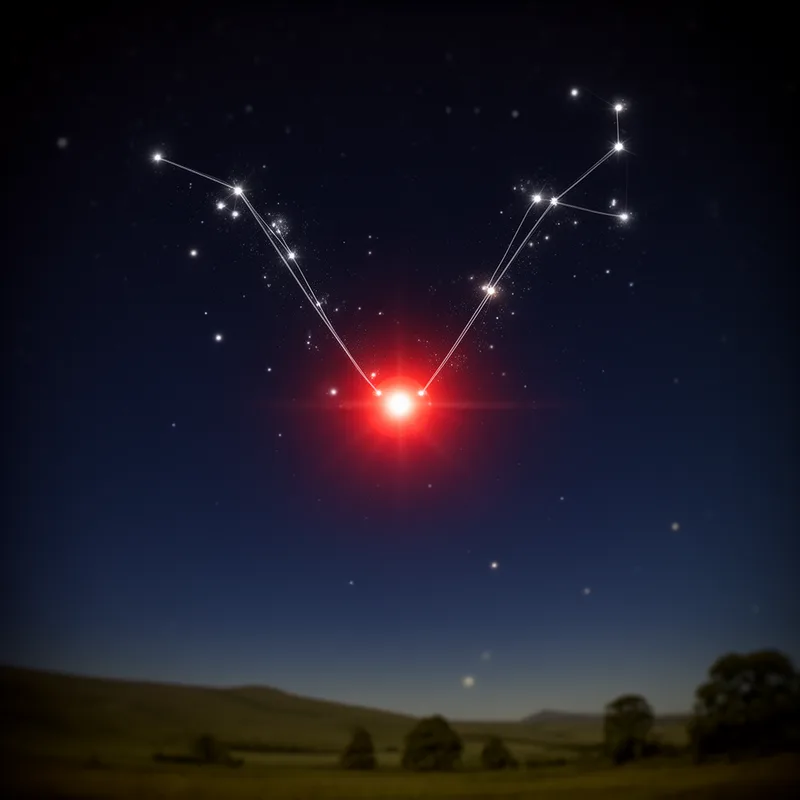
Aldebaran
 2
9.4

- proper noun
- /ælˈdɛbərən/
- We knew that Orion was following the Pleiades, and that we therefore had not far to look for Taurus and the excellently bright Aldebaran, whose Arabic name tells us he too is "the follower" of those enchanting sisters.
- Aldebaran star
- the brightest Aldebaran
- occultation of Aldebaran
Examples
-
The red planet Mars now outshines Aldebaran and will become nearly fourteen times brighter by late November.
Academic text (1990) -
Observers in central and western states will view the Moon and Aldebaran in a dark sky.
-
And to our left of Aldebaran is the bright planet Jupiter.
Blog text (34) -
And let it drift off to Aldebaran the moment the ship makes a course correction.
Fiction book (2002) -
Jupiter on one flank, Aldebaran on the other.
Blog text (4) -
And almost directly above Aldebaran are the "Seven Sisters" or "Pleiades," that distinctive little dipper-shaped cluster of stars.
Blog text (34) -
The pair of reddish objects below the moon are the Bull's brightest star, Aldebaran, and even brighter Mars.
Academic text (1990) -
The orange star Aldebaran shines brightly along the bottom (to us) of this triangle.
Blog text (34) -
October 8: After 9:00 P.M., look in the east for the waning gibbous moon and Mars, almost in line with Aldebaran and the V-shaped Hyades cluster.
Academic text (1990) -
On December 7, the planet passes 5 degrees due north of Aldebaran, Taurus's orange-colored luminary.
Surface Forms
Etymology
Aldebaran comes from the Arabic name al-dabarān, which means 'the follower'. People called it that because it seems to follow the Pleiades, a small group of stars, across the night sky, so the name helps you remember this bright red star.