
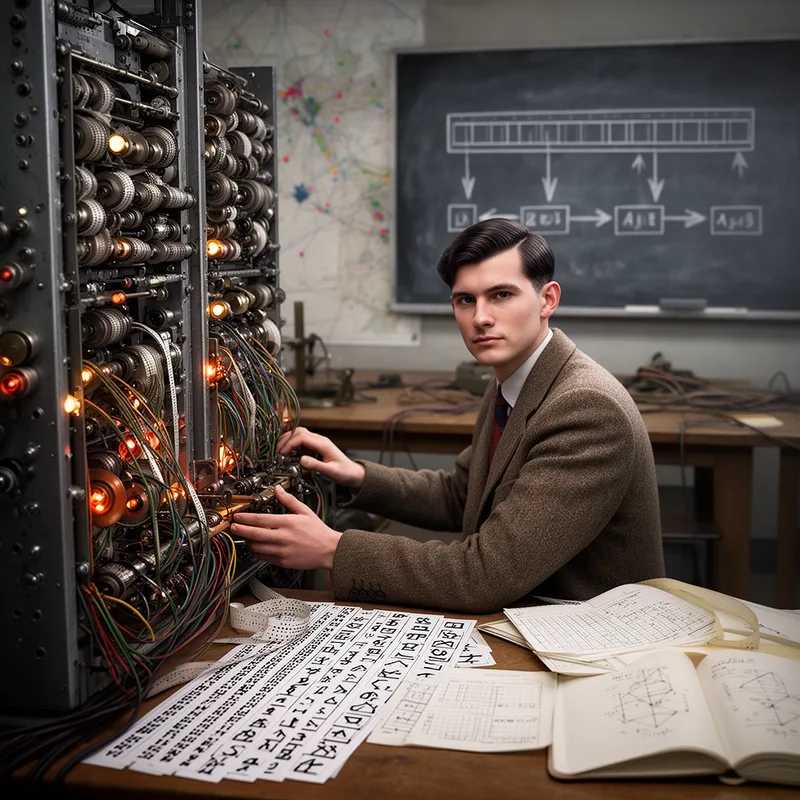
Alan Turing
- proper noun
- Many universities commemorate Alan Turing through lectures and scholarships in his name.
Examples
-
Alan Turing is celebrated as the father of theoretical computer science and artificial intelligence.
-
In his groundbreaking work, Alan Turing proposed the concept of the Turing machine, which laid the foundation for modern computing.
-
The team credited Alan Turing with shortening World War II by years through his codebreaking work.
-
Many people consider Alan Turing to be the father of computer science.
-
Did you know Alan Turing was pivotal in breaking the Enigma code?
-
Alan Turing was a brilliant mathematician who played a key role in cracking the Enigma code during World War II.
-
The film "The Imitation Game" highlights the life of Alan Turing, focusing on his contributions to codebreaking in World War II.
Synonyms

 17
6.1
17
6.1

A British scientist who helped create modern computers and artificial intelligence
An English mathematician who invented the idea of a computing machine and broke German codes during World War II
Surface Forms
Morphology
Alan + Turing
This is a referential proper name identifying a specific historical person; the encyclopedic meaning (his life, role as a mathematician and codebreaker) cannot be compositionally derived from the constituents. Proper names function as arbitrary labels so even learners who know the words 'Alan' and 'Turing' would not infer the biographical or technical information, making the expression unpredictable from its parts.
Etymology
Alan Turing belongs to a real English mathematician and codebreaker from the 1900s. He created the idea of the Turing machine, which is like a very simple machine that reads and writes marks on a long strip of paper to follow rules and act like a tiny 'brain'. He also helped break German codes during World War II, and that's why his name now stands for 'computer science' and the idea of machines that can 'think'.