
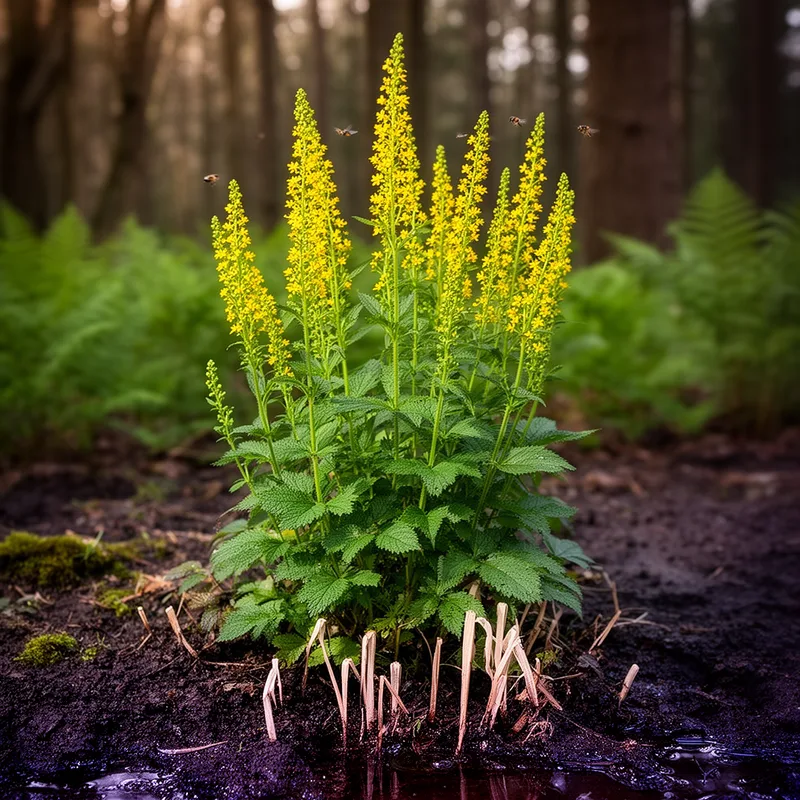
Agrimonia procera
- noun
- Specialized
- Agrimonia procera is often found along the edges of woodlands, where the soil is moist and rich.
Examples
-
Botanists often study Agrimonia procera for its distinctive fragrant leaves and yellow flowers.
-
The conservation group is working to preserve habitats for Agrimonia procera and other native plants.
-
Agrimonia procera can be found growing in the damp woodland areas of central Europe.
-
The Agrimonia procera grows beautifully in shaded areas.
-
Have you ever seen Agrimonia procera in bloom?
-
Many herbalists value Agrimonia procera for its fragrant aroma and potential medicinal properties.
-
Agrimonia procera grows well in areas that receive dappled sunlight and consistent moisture.
Synonyms

A European plant that lives for several years and has a pleasant smell at the edges of woods
Surface Forms
Morphology
agrimonia + procera
This is a Linnaean binomial: 'Agrimonia' clearly identifies the genus (a flowering plant), so a learner who knows that constituent can infer it names a particular kind of Agrimonia. However, the species epithet 'procera' is a Latin taxonomic label (not a productive English morpheme) and does not yield the detailed meaning 'fragrant European perennial herb,' so the full sense is not recoverable from the parts alone.
Etymology
Agrimonia procera probably comes from old Latin and Greek words: Agrimonia from a word for 'field' or 'wild plant' and procera from Latin for 'tall'. So the name paints a picture of a tall, wild herb, which fits this fragrant plant that grows at the edges of woodlands.

