
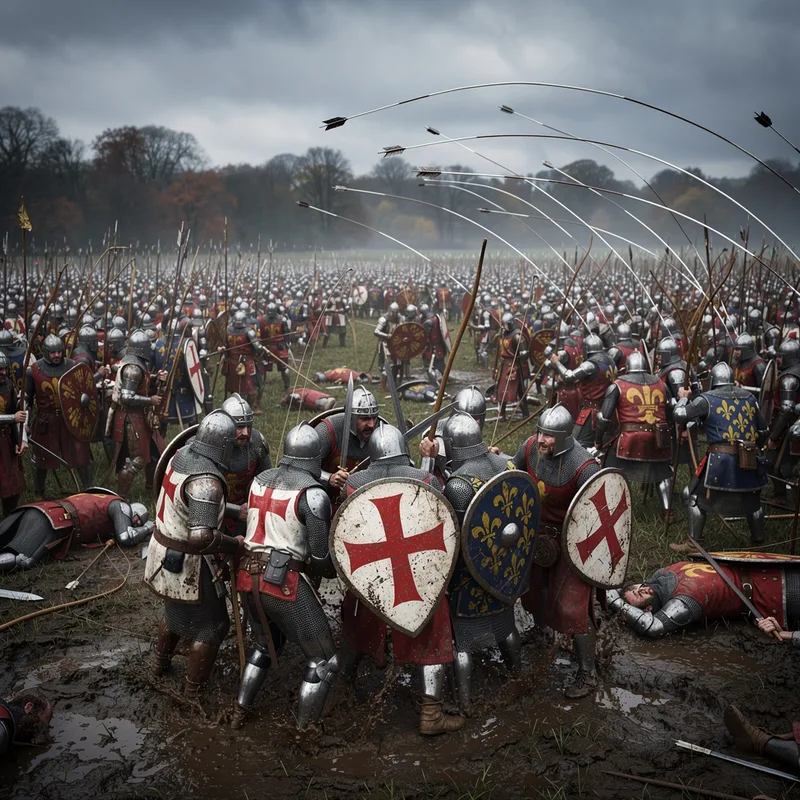
Agincourt
 3
9.9
3
9.9

- proper noun
- /ˈædʒɪnˌkɔr/
 :
Agincourt
:
Agincourt
- At Agincourt he wins; in later days, the king's son uneasy lies, and then takes flight.
- the Battle of Agincourt
- victory at Agincourt
- Agincourt in 1415
Examples
-
As the English longbow spelled the end of armored knights at Agincourt, the machine gun marked the final defeat of the cavalry charge in World War I.
Fiction book (1997) -
At the end of the Battle of Agincourt in Henry V, King Hal told his bloodied troops.
Blog text (34) -
Yeah, but imagine getting Henry into that for the Battle of Agincourt.
-
Like Agincourt, site B requires a completely alternate history of the battle.
Blog text (19) -
The use of archers at Agincourt was one of his examples.
Blog text (12) -
As an encore I do the Battle of Agincourt.
-
We fought at Crecy, at Bosworth Field, at Agincourt.
-
"Agincourt?" He flung the question through his horn, his heart leaping.
Fiction book (1994) -
Can this cockpit hold the vasty fields of France or may we cram within this wooden "o"... the very casques that did affright the air at Agincourt?
-
The English forces achieved a remarkable victory against the French army at the Battle of Agincourt in 1415.
Synonyms
 1
9.3
1
9.3
A famous fight in northern France in 1415 where English soldiers beat a larger French army
Compounds
1
9.3
A famous fight in northern France in 1415 where English soldiers beat a larger French army
Surface Forms
Etymology
Agincourt comes from the old French village name Azincourt, made of a man's name Azo and court, which means 'enclosed farm' or 'estate'. Think of it as 'Azo's farm', the small place whose name later marked the famous 1415 battle.