
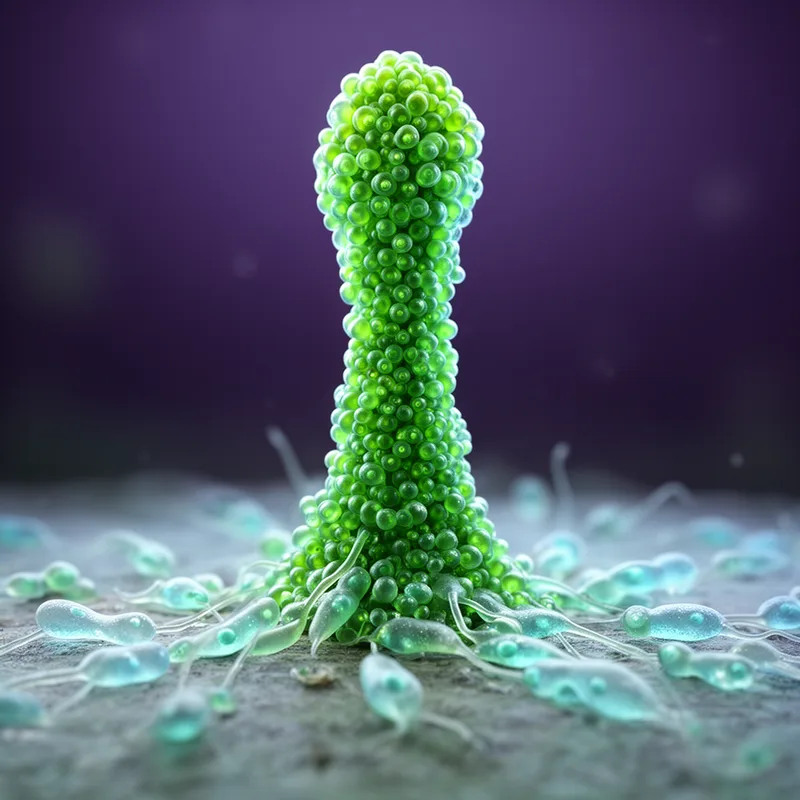
Acrasiomycetes
- noun
- /ˌækrəziˈmaɪsiːtiːz/
- Specialized
- The Acrasiomycetes aggregate when food is scarce, forming a fruiting body to disperse spores.
Examples
-
Unlike true fungi, Acrasiomycetes spend part of their life cycle as single-celled amoebae.
-
Scientists often study Acrasiomycetes to understand the evolution of multicellularity.
-
The Acrasiomycetes are fascinating.
-
Are Acrasiomycetes important for understanding evolution?
-
Researchers found that Acrasiomycetes can rapidly change from single cells to a multicellular organism when conditions are favorable.
-
In laboratories, Acrasiomycetes are used to model the behavior of cells during the development of multicellular structures.
-
During their life cycle, Acrasiomycetes demonstrate unique characteristics that distinguish them from other slime molds.
Surface Forms
Morphology
Acrasiomycetes = Acrasiomycete (opaque) = acrasio + mycete + s
The immediate base is a scientific class name formed from specialized Greek combining forms; this formation is not transparent to an average B1 learner.
Etymology
Acrasiomycetes combines acrasi- from Greek meaning 'without rule' or 'lack of unity' and -mycetes meaning 'fungus' or 'mushroom'. So the name gives a picture of single-celled amoebae that are not true fungi but can come together into many-celled, fungus-like groups, which explains why we call them a class of slime molds.

