
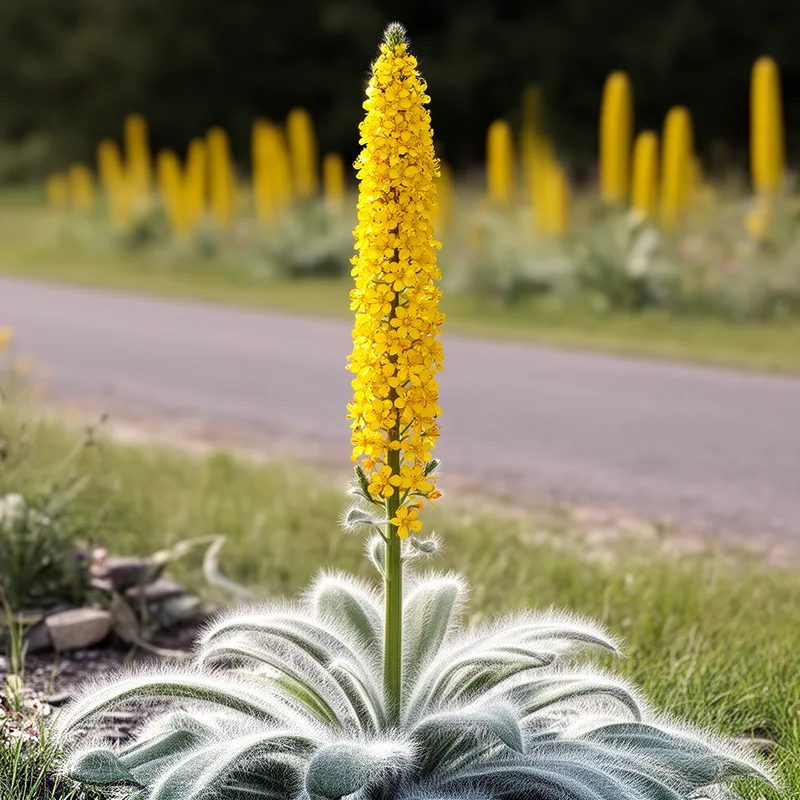
Aaron's rod
- noun
- Gardeners often plant Aaron's rod for its decorative yellow flowers and resilience.
Examples
-
In ancient ceremonies, people used dried Aaron's rod as torches.
-
The tall spikes of Aaron's rod could be seen growing along the roadside.
-
In ancient times, Aaron's rod was used to make torches.
-
The Aaron's rod grows tall and has dense yellow flowers.
-
In ancient ceremonies, people used dried Aaron's rod as torches.
-
In ancient times, Aaron's rod was used to make torches.
-
Gardeners often plant Aaron's rod for its decorative yellow flowers and resilience.
Synonyms

A tall plant with soft, hairy leaves and long spikes of yellow flowers

A tall plant with soft woolly leaves and spikes of yellow flowers used long ago as torches
A tall plant with soft woolly leaves and yellow flower spikes

A tall plant with soft, hairy leaves and yellow flowers
A tall plant with soft hairy leaves and bright yellow flowers
Surface Forms
Morphology
Aaron's + rod
The element 'rod' gives a partial clue (something long and stick-like), but the possessive proper name 'Aaron's' requires cultural/biblical knowledge and does not signal a plant species. The overall meaning (a tall woolly plant formerly used for torches) is not directly derivable from the parts, so the expression is only partially transparent to a B1 learner.
Etymology
Aaron's rod may come from the Bible story of Aaron's long staff because the plant has a tall, straight flower stalk that looks like a rod, and people long ago dried these stalks and used them as 'torches'. That's why the name links the plant to Aaron's 'rod' and helps you remember its long, staff-like shape.

