
women's work
 4
3.4
4
3.4

- noun
- /ˈwɪmɪnz wɜrk/
- "Beadwork, full of color, proclaims another Africa, one of light, abstraction, and women's work."
- attitudes toward women's work
Examples
-
In the present study, we explored attitudes toward women's work in general.
Academic text (2000) -
Evidence suggests that these issues will remain important in women's work lives.
Academic text (1990) -
- Well, a woman's work is never done.
-
A woman's work is never done.
-
The day will soon come when you long for the safety and comfort of women's work.
Fiction book (1993) -
Indigenous economies and women's work changed considerably under Spanish rule.
Academic text (1999) -
You know, the Hmong consider gardening to be women's work.
-
Instead, these scholars have concentrated on women's work within the more traditional humanitarian reform movements of the nineteenth century.
Academic text (1990) -
In Turkey, women's work in factories is divided both horizontally and vertically.
Academic text (2008) -
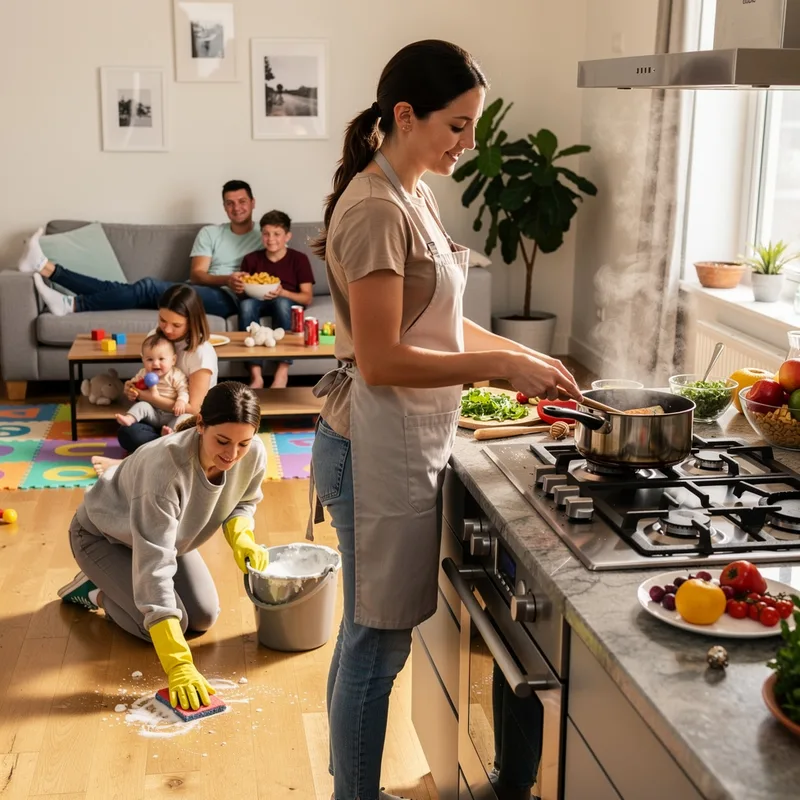
Cooking and cleaning are often seen as women's work in many cultures.
Synonyms
 61
1.8
61
1.8
Work that keeps a home clean and running, like cleaning and cooking
 42
1.0
42
1.0
Regular cleaning and small tasks to keep a home tidy
 8
1.2
8
1.2
A regular task at home like cleaning or cooking

Managing a home and doing daily tasks like cooking and cleaning
How Domestic

Surface Forms
Morphology
women's + work
The phrase is compositionally built from 'women's' (possessive of women) + 'work' (tasks), so a B1 learner who knows those words can infer it denotes work associated with or done by women. While the socio-cultural stereotype component (that certain domestic tasks are 'traditionally' women's responsibility) may require world-knowledge, the basic referential meaning is directly derivable and cross-linguistically paralleled, so it is transparent.
Etymology
Women's work comes from old family life, where everyday jobs like cooking, cleaning and caring for children were done by women and called their work. That's why the phrase now means 'tasks seen as the responsibility of women'.