
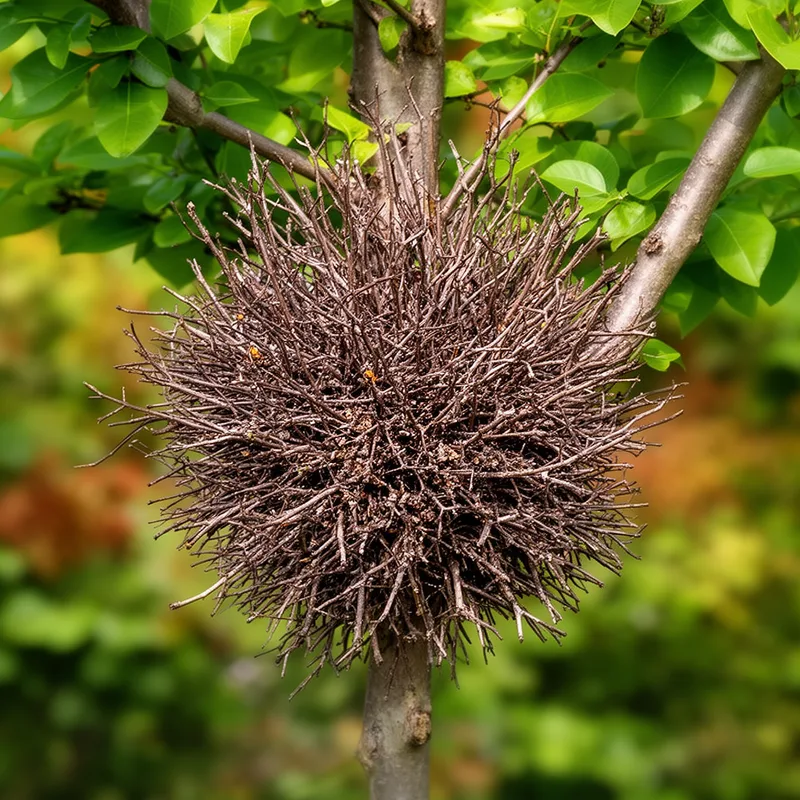
witches' broom
- noun
- /ˈwɪtʃɪz bruːm/
- Specialized
- Gardeners are concerned when they spot witches' broom on their ornamental shrubs.
Examples
-
Look at that witches' broom!
-
The ash tree developed a noticeable witches' broom after a fungal infection.
-
A severe case of witches' broom can affect the overall health of the plant.
-
The witches' broom on that tree looks unusual.
-
The tree had a witches' broom, making it look unusual with dense clusters of twisted branches.
-
Gardeners often notice witches' brooms on shrubs, which can be harmful if left untreated.
-
After a storm, we found a witches' broom on the oak tree in our backyard, indicating a possible infection.
Synonyms

A dense cluster of twigs growing from one point on a tree

A thick cluster of small branches that grows from one spot on a tree, often after fungus or insect damage
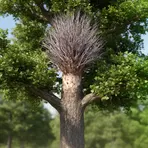
A tuft of small dead branches on a tree caused by disease or insect attack
Surface Forms
Morphology
witches' + broom
The phrase evokes a metaphorical image (a cluster of twigs resembling a broom), so a learner who knows 'witch' and 'broom' could partly infer it refers to a broom‑like growth. However the specific botanical sense—an abnormal dense cluster of shoots caused by fungi or insects—is technical and not fully predictable from the constituents (and 'broom' also has a distinct shrub sense), making the expression only partially transparent.
Etymology
Witches' broom comes from a simple image: a tight bundle of small branches that looks like a broom. One popular story says people thought these odd clumps were made by witches, so the name stuck and now it means 'a dense cluster of shoots' on a tree.

