

weaver's broom
- noun
- UK
- The flexible twigs of the weaver's broom are ideal for making baskets and brooms.
Examples
-
The pale yellow blossoms of the weaver's broom brighten the Mediterranean hillsides each spring.
-
Farmers in California have planted weaver's broom along roadsides for soil stabilization.
-
The weaver's broom is known for its slender twigs.
-
I found some weaver's brooms in the garden.
-
The flexible twigs of the weaver's broom are ideal for making baskets and brooms.
-
Farmers in California have planted weaver's broom along roadsides for soil stabilization.
-
The pale yellow blossoms of the weaver's broom brighten the Mediterranean hillsides each spring.
Synonyms

 9
5.0
9
5.0

A shrub with thin green stems and yellow flowers that helps hold soil

A tall thornless bush with pale yellow flowers and flexible twigs used for weaving baskets
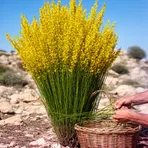
A tall thornless shrub from the Mediterranean with sweet-smelling yellow flowers and flexible stems used to make baskets
Surface Forms
Morphology
weaver's + broom
The phrase combines the familiar noun 'weaver' (a person who weaves) with 'broom' (a shrub), and the possessive form signals a shrub associated with or used by weavers. The botanical/use sense (a shrub used for weaving baskets) is directly inferable from the constituents and common possessive compounding, so a B1 learner who knows both words would understand the MWE.
Etymology
Weaver's broom got its name because its long, flexible twigs were used by people who wove baskets and made brooms. So the name points to a bush whose twigs were used 'to weave' and to make a 'broom'.