
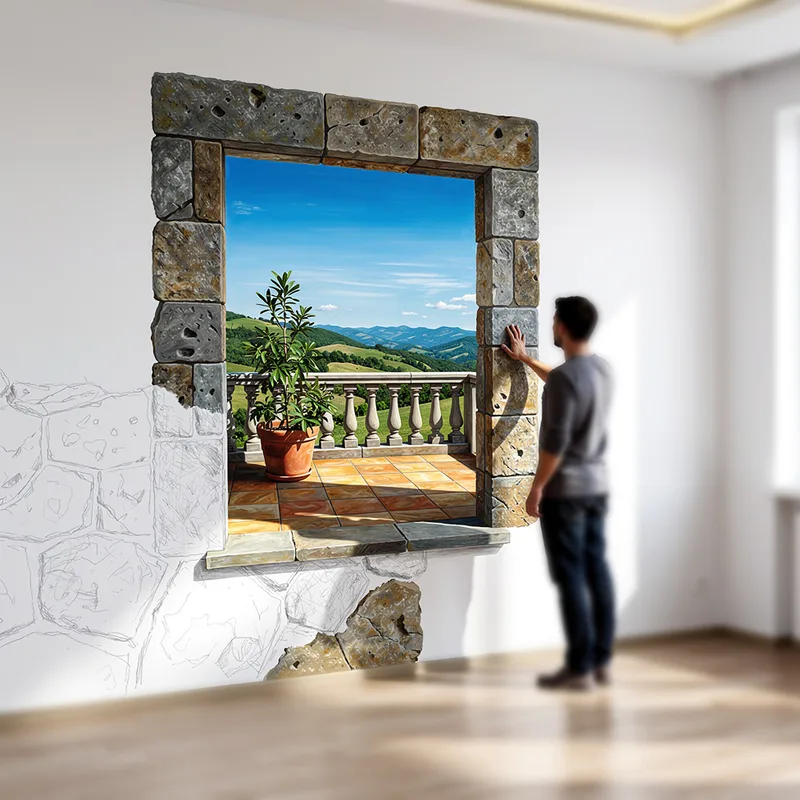
trompe l'oeil
 2
9.9

- noun
- /trɒmp ləˈwɛl/
- Jargon
- The gallery features a stunning trompe l'oeil mural that makes the ceiling appear much higher.
- trompe l'oeil ceiling
Examples
-
The trompe l'oeil ceiling was a design by Walpole and Bentley, painted by Andien de Clermont in 1754.
Academic text (2013) -
Swallows soar across the low ceiling in a trompe l'oeil painting of a paradisiacal sky.
Academic text (2002) -
It's Martin Margiela, so yes, it's some kind of trompe l'oeil.
Blog text (28) -
The trompe-l'oeil illusion here is no longer closed within parallel flatnesses, but seems to thrust through the surface of the drawing paper and establish depth on top of it.
Academic text (2002) -
It was merely a trompe l'oeil brought to you by Bergeson's OSPI.
Blog text (28) -
Bellini and Carpaccio, among others, had established the Venetians' reputation as skilled manipulators of optical effects, including trompe l'oeil.
Academic text (1998) -
The imagorium's trompe l'oeil ceiling further challenges place and time, directing one toward Paradise; yet just as release seems at hand, attention is redirected inward through the hidden messages and powers of the sacred images.
Academic text (2002) -
This trompe l'oeil Korean interior ad campaign struck us as less dominating than destabilizing, as fitting for a flood warning as for a beach vacation daydream.
Blog text (28) -
When present, signatures not only took part in the larger illusion fashioned by the painter, they often served as trompe l'oeil devices in themselves that acted to impress the viewer with the painter's skill in more varied and assertive ways.
Academic text (1998) -
Certainly, their growing preference for Roman lettering and a more vivid trompe l'oeil illusionism announced their familiarity with the Renaissance visual vocabulary as it had been developing elsewhere on the peninsula.
Academic text (1998)
Synonyms

 1
9.9
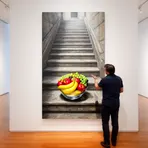
A painting style that makes painted things look real, like a staircase or fruit
How Realistic

Surface Forms
Morphology
trompe + l'oeil
This is a French loanphrase literally meaning 'deceives the eye'; if a learner knows the constituents (trompe = deceive, l'oeil = the eye) they can infer it refers to visual deception or an optical illusion. However, the words are not English and the term is a specialized art technicality, so comprehension depends on knowledge of the foreign constituents and may not be fully predictable to an average B1 learner, making it only partially transparent.
Etymology
The noun trompe l'oeil comes from French words trompe and l'oeil, which mean 'fool' and 'the eye'. Painters use careful lines and shadows to 'fool the eye' so a flat wall looks three-dimensional, and that's why trompe l'oeil means a painting that looks real.