
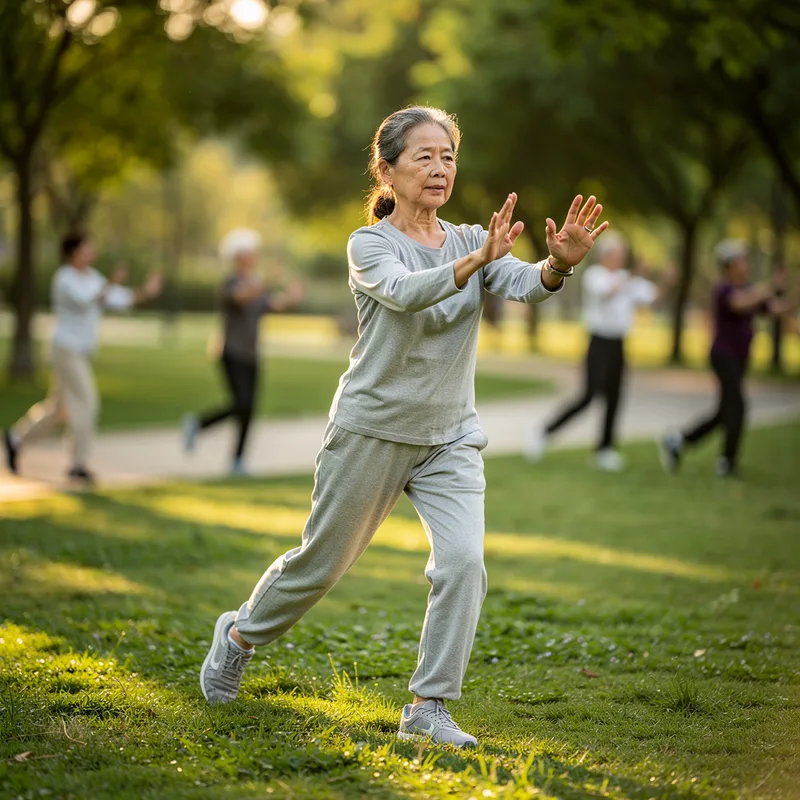
t'ai chi
 1
7.0
1
7.0

- noun
- /taɪ ˈtʃi/
- He enjoys the smooth, flowing movements of t'ai chi during his morning exercises.
- T'ai Chi exercise
- T'ai Chi class
- benefits of T'ai Chi
Examples
-
All three domains showed the positive effects of T'ai Chi exercise.
Academic text (2003) -
Another participant stated, "I participated in all 12 sessions and am planning to continue the T'ai Chi program."
Academic text (2003) -
I discovered something similar in my T'ai Chi Chuang class this past summer.
Blog text (28) -
The purpose of this study is to examine the effects of T'ai Chi exercise on FM symptoms and health status for individuals with FM.
Academic text (2003) -
Additionally, participants volunteered comments regarding the benefits of T'ai Chi exercise participation.
Academic text (2003) -
T'ai Chi, an ancient Chinese exercise, combines physical exercise with mind-body therapy.
Academic text (2003) -
Participants then engaged in 6 weeks of twice-weekly 1-hour T'ai Chi classes.
Academic text (2003) -
T'ai Chi exercise, often called meditation in motion, combines aspects of mind-body therapy and physical exercise.
Academic text (2003) -
T'ai Chi involves specific sequencing of movements while focusing on breathing, body posture, and balance.
Academic text (2003) -
Thirty-seven adults with FM volunteered to participate in the 6-week T'ai Chi classes.
Academic text (2003)
Synonyms
 10
3.7
10
3.7
A slow, gentle Chinese exercise that uses smooth movements to relax and improve balance

 1
6.5
1
6.5
Slow gentle movements that relax the body and improve balance and health
Slow flowing Chinese exercises that help relax the body, calm the mind, and improve balance
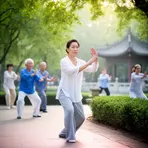
A slow Chinese exercise of gentle body movements and breathing to relax and improve balance
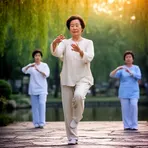
A Chinese gentle exercise of slow movements and calm breathing that improves balance
How Vigorous

Surface Forms
Morphology
t'ai + chi
The constituent 'chi' (life energy) gives a learner a partial clue that the term relates to energy or internal practice, but 't'ai' is not a transparent English morpheme and the compound is a borrowed name for a specific Chinese system. The full meaning — a slow, meditative system of physical exercise and martial art for balance and health — cannot be reliably derived by a B1 learner from the parts alone, so it is only partially transparent.
Etymology
T'ai chi comes from an old Chinese idea of balance between two opposite forces, shown as yin and yang, and it grew from slow, controlled martial-arts moves sometimes called 'shadow boxing'. That's why t'ai chi today is a slow, calm exercise people use for balance, relaxation, and health.