

nurse's aide
 7
2.9
7
2.9

- noun
- /ˈnɜrsɪz eɪd/
- US
- The nurse's aide prepared the patient's medication and assisted with daily activities.
- a male nurse's aide
- works as a nurse's aide
Examples
-
Mom worked as a nurse's aide for a few years, but mostly was a homemaker.
Blog text (15) -
A nurse's aide was wheeling her toward the front desk to be released.
Fiction book (1990) -
I'm a fully qualified nurse's aide.
-
She is a nurse's aide, you know, low pay and all that.
-
The duties of the nurse's aides are most visible on the day shift in the heavy-care wing.
Academic text (1994) -
I buzz for Sheila, my favorite, a tall young nurse's aide with the grace of a gazelle.
Fiction book (1995) -
The nurse's aide, personal care worker, or homemaker often has great responsibilities without commensurate authority.
Academic text (1994) -
"Outside her room, a nurse's aide pushed a jiggling cart of food trays down the corridor.
Fiction book (1992) -
The dominant staff of long-term-care institutions are nurse's aides, who are supervised by nurses.
Academic text (1995) -
Mary passed the time chatting with the nurse's aide, who knitted socks from wool she'd spun herself.
Fiction book (1998)
Synonyms
 365
3.5
365
3.5
A person who helps someone in a job, for example a teacher or politician
 15
4.5
15
4.5
A hospital worker who helps with tasks like moving patients and cleaning

 1
3.2
1
3.2
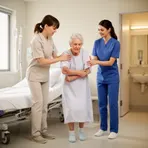
A person who helps nurses with basic patient care tasks
How Trained
- Specialized
19
2.8

- Specialized
1
3.5
- US
7
2.9
- UK
Surface Forms
Morphology
nurse's + aide
The possessive 'nurse's' (belonging to a nurse) combined with 'aide' (an assistant) directly yields the meaning 'an assistant who helps a nurse'. This composition follows a straightforward possessive + agent noun pattern common across languages, so a B1 learner who knows the constituent words will readily infer the MWE meaning.
Etymology
Nurse's aide shows the simple image of an aide, a 'helper', working with a nurse to do small patient tasks like washing, feeding, or helping someone get out of bed. So, it means 'a person who helps a nurse with basic patient care, often with little formal training'.