

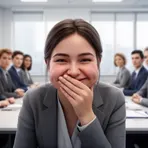
to laugh one's head off


 1
3.5
1
3.5
- idiom
- Informal
- When she told the story about the dog in the park, I couldn't stop laughing my head off.
Examples
-
Go ahead, laugh your head off.
-
When I came back and changed my color, and saw all those stupid television news stories of the anguished Nigerian and the reward he was offering, I simply laughed my head off.
Fiction book (1990) -
You know, we're all laughing our heads off.
-
-I'm laughing my head off at this.
-
No, you'll laugh your head off.
-
My boss is laughing his head off, Robert (and so is my team).
Blog text (21) -
He damn near laughed his head off.
Fiction book (2001) -
You will find you'll laugh your head off, Lord Carem.
Fiction book (1995) -
First they'd... they'd laugh their heads off.
-
Appalling display of cowardice, she would've been right... ...to run around the school laughing her head off.
Synonyms
 18
3.5
18
3.5
To laugh loudly and without control
 15
3.4
15
3.4
Laugh loudly and without control
 9
3.0
9
3.0
Start laughing very hard and cannot stop
 8
2.4
8
2.4
To suddenly start laughing loudly and not be able to stop
 4
6.5
4
6.5
To laugh suddenly and loudly without control
 3
5.1
3
5.1
To make loud, long sounds because something is very funny
 1
8.6
1
8.6
To laugh loudly in a silly, noisy way
 1
5.6
1
5.6
To laugh very hard
 1
9.7
1
9.7
To laugh very hard at something funny online

To laugh loudly because something is very funny

Feel so amused that you fall over and move on the floor

Laugh so hard that your body shakes

To laugh so hard you almost choke
Antonyms
How Intense

Surface Forms
Morphology
laugh + one's + head + off
The meaning 'to laugh very loudly' is a conventionalized hyperbolic idiom and cannot be derived compositionally from 'laugh' + 'one's head' + 'off' — the literal idea of removing a head does not map to intense laughter. Because the relation is metaphorical and unpredictable from the parts, a B1 learner who only knows the constituent words would not reliably infer the idiomatic meaning.
Etymology
Laugh one's head off comes from a wild image: imagine laughing so hard your head might come off. One popular story says people used that picture to show very strong laughter, so the phrase now means 'to laugh very loudly'.