
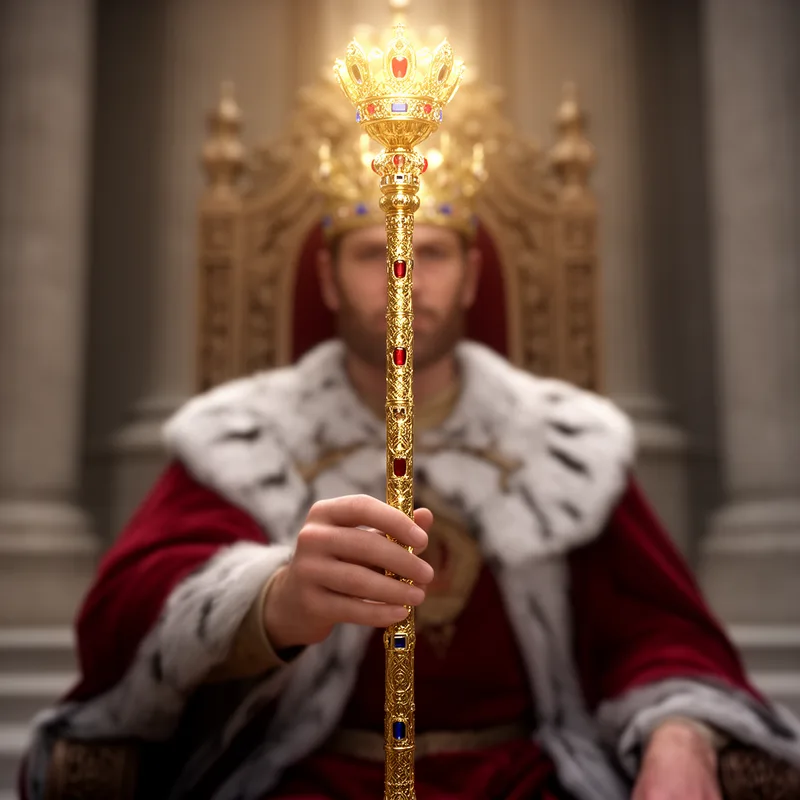
king's sceptre
- noun
- /kɪŋz ˈsɛptər/
- UK
- At the coronation, the monarch held the king's sceptre as a sign of his rule.
Examples
-
A golden king's sceptre was passed down through generations of royalty.
-
The ornate king's sceptre was displayed in the royal treasury for all to see.
-
The king's sceptre symbolizes his authority.
-
During the ceremony, the king's sceptre was displayed prominently.
-
During the coronation, the new king raised his king's sceptre high, signifying the beginning of his reign.
-
In the museum, visitors marveled at the intricately designed king's sceptre used by past monarchs.
-
The royal king's sceptre was embellished with precious jewels, representing the kingdom's wealth and power.
Synonyms
 105
4.5
105
4.5

A long stick used for support or as a sign of authority
 67
8.0
67
8.0
A decorated staff held by a ruler to show power
 2
8.2
2
8.2
A decorated staff carried at official events to show authority
How Ornate

Surface Forms
Morphology
king's + scepter
The meaning is directly compositional: 'king's' marks possession and 'sceptre' is a decorated staff, so a B1 learner who knows both constituents can infer it denotes the ceremonial staff belonging to a king. This is a literal possessive noun phrase following common cross-linguistic patterns, making it immediately understandable from its parts.
Etymology
The noun king's sceptre comes from the real object a king carried: a long, decorated sceptre he held at ceremonies. Because the ruler held this staff where everyone could see, it became a clear sign 'of authority' and 'sovereignty'.