
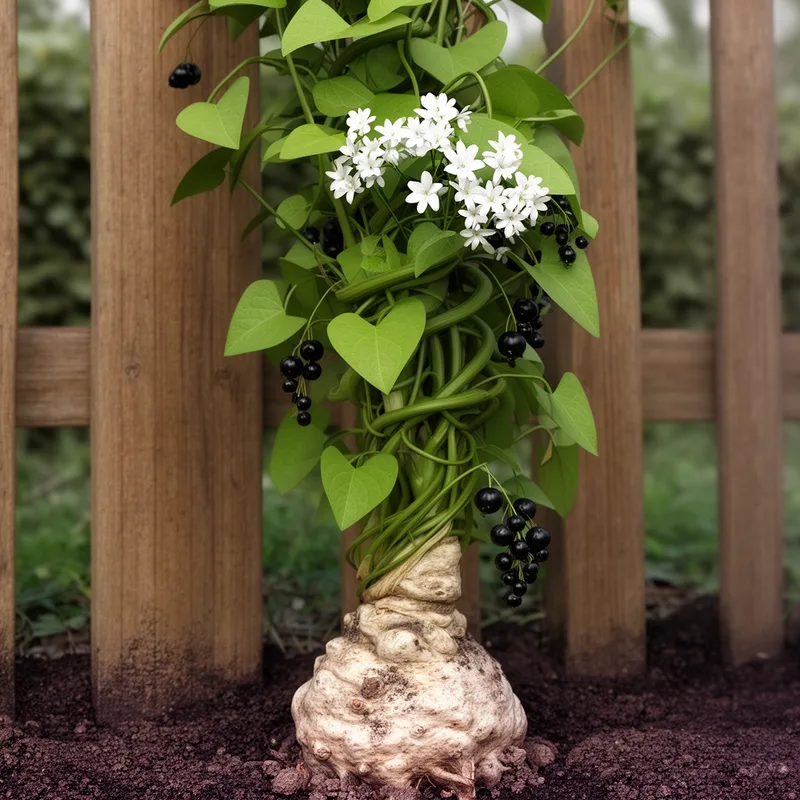
devil's turnip
- noun
- UK
- The hedgerow was tangled with devil's turnip, its white flowers in full bloom.
Examples
-
Gardeners warned that devil's turnip berries are poisonous if ingested.
-
She studied the thick, gnarled root of the devil's turnip before painting it.
-
The devil's turnip is often found in gardens.
-
Many people are unaware of the devil's turnip plant.
-
Gardeners warn that devil's turnip berries can be toxic if eaten.
-
The thick white flowers of the devil's turnip climb over the garden fence.
-
She harvested the roots of the devil's turnip for her botanical study.
Synonyms

A climbing plant with white flowers, thick roots, and small black berries

A climbing vine with white flowers, thick roots, and small black poisonous berries
Surface Forms
Morphology
devil's + turnip
The word 'turnip' will cue a B1 learner to a plant/root-vegetable and 'devil's' signals an ominous, figurative or poisonous quality, so learners can infer it refers to some kind of plant with negative or unusual attributes. However, the specific botanical identity and properties (a white‑flowered climbing plant with small black berries rather than a true turnip) are not derivable from the parts alone, so the meaning is only partially predictable.
Etymology
Devil's turnip gets its name from the plant's thick white root that looks like a turnip and from its small black berries. Because those berries and the root can be 'poisonous', people put 'devil's' in the name as a warning that the plant is 'dangerous'.

