
Tzolk'in


 1
9.9
- noun
- /ˈzoʊl.kɪn/
- Specialized
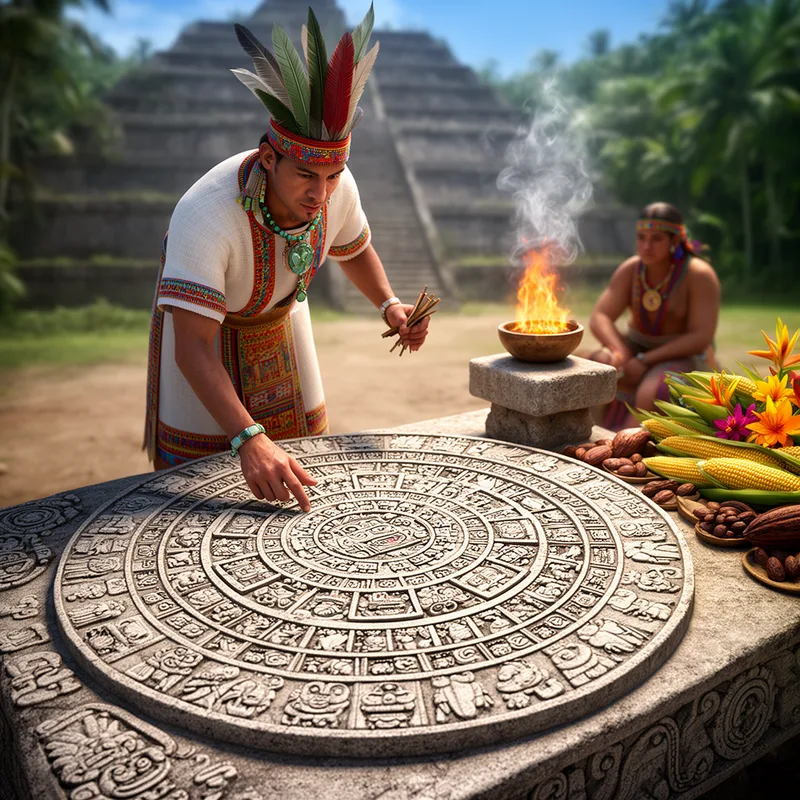
- The ancient Maya believed that the Tzolk'in, a 260-day sacred calendar, governed their religious ceremonies.
Examples
-
The two main calendars were a ceremonial calendar (the Tzolk'in), a 260-day calendar of 13 numbers and 20 day names, and the vague calendar (the Haab), of 365 days.
Blog text (27) -
The 260-day Tzolk'in, or sacred calendar, is the oldest calendar cycle known in Mesoamerica, dating back to at least 600 B.C.E.
Academic text (2004) -
The Haab was in use by at least 100 B.C.E. and was created to be used in conjunction with the Tzolk'in.
Academic text (2004) -
As a testimony to the Tzolk'in's centrality to Maya culture, it is still observed today among traditional Maya groups.
Academic text (2004) -
In its completed form, the Maya calendar had four interlocking cycles: the Tzolk'in, the Haab, the "Long Count," and the lunar series.
Academic text (2004) -
DIAGRAM: The Maya calendar had four interlocking cycles: the Tzolk'in, the Haab, the "Long Count," and the lunar series.
Academic text (2004) -
Many traditional Maya communities still follow the Tzolk'in for planning important events and rituals.
-
The Tzolk'in consists of 13 numbers and 20 named days, forming a unique cycle used for spiritual purposes.
Surface Forms
Etymology
The word Tzolk'in comes from a Maya language and is made of two parts, tzol and k'in, which mean 'count' and 'day'. So the Tzolk'in is literally a 'count of days', which helps explain why it is the sacred 260-day calendar the Maya used for ceremonies.