
Takayasu's arteritis
- noun
- /ˌtɑːkəˈjuːs əˈrˌtɪtɪs/
- Specialized
 :
arteritis de Takayasu
:
arteritis de Takayasu
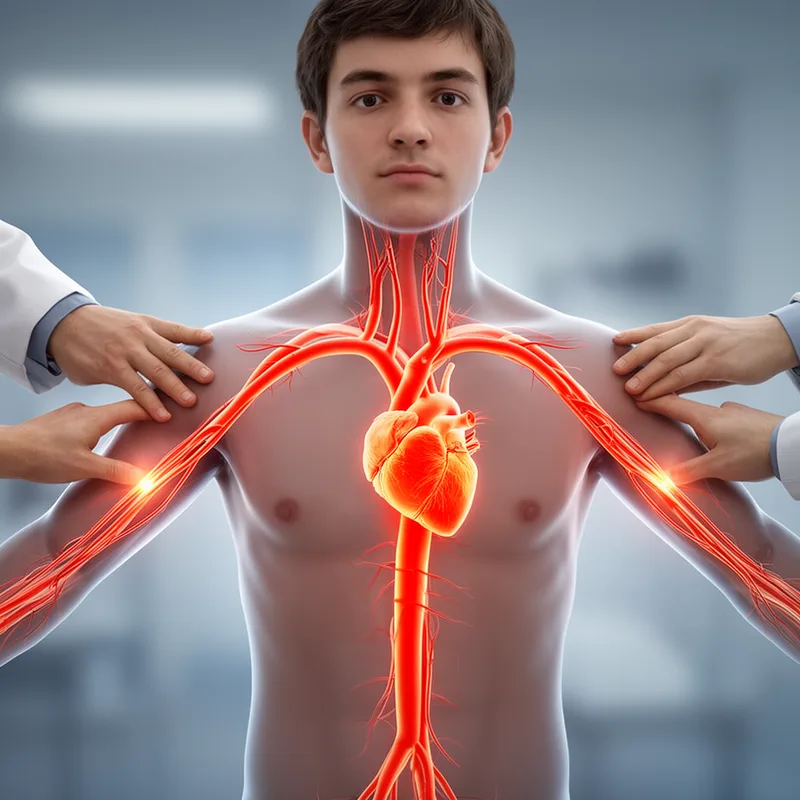
- Patients with Takayasu's arteritis often present with absent pulses in their upper limbs.
Examples
-
The diagnosis of Takayasu's arteritis can be challenging due to its nonspecific early symptoms.
-
Current treatments for Takayasu's arteritis aim to reduce vascular inflammation and prevent complications.
-
Doctors diagnosed her with Takayasu's arteritis last year.
-
Is Takayasu's arteritis common among young women?
-
Patients with Takayasu's arteritis often have difficulty detecting pulses in their arms and neck due to the condition.
-
Current research focuses on finding more effective treatments for Takayasu's arteritis to improve blood flow.
-
Early signs of Takayasu's arteritis may include fatigue and lower blood pressure in patients.
Synonyms

Swelling of large blood vessels like the aorta that makes arm or neck pulses hard to feel
Surface Forms
Morphology
Takayasu's + arteritis
A learner who knows 'arteritis' (inflammation of arteries) and recognizes 'Takayasu's' as a proper-name possessive can infer this is a specific type of arteritis named after Takayasu, so the basic concept (arterial inflammation) is recoverable. However, the full clinical meaning—its restriction to large vessels like the aorta, its rarity, and characteristic signs (e.g. absent pulses)—is not predictable from the constituents, so the expression is only partially transparent.
Etymology
Takayasu's arteritis was named after Dr. Mikito Takayasu, who first noticed odd patterns in blood vessels during an eye exam. Later doctors found the same problem in the large arteries, where the vessels become swollen ('inflammation') and can make the 'pulse' in the arms disappear, so the name now means this specific artery disease.

