
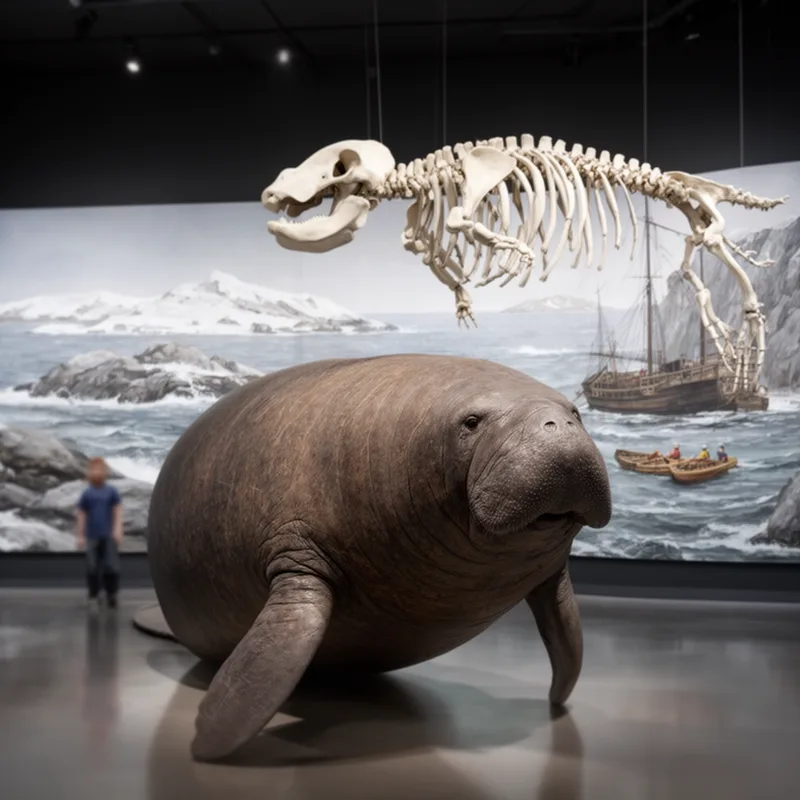
Steller's sea cow
- noun
- /ˈstɛlərz siː kaʊ/
- Specialized
- The Steller's sea cow was a large marine mammal that lived in the Bering Sea before it went extinct in the 18th century.
Examples
-
The extinction of the Steller's sea cow is a cautionary tale of overhunting by humans.
-
The remains of a Steller's sea cow were discovered on a remote island in the Bering Sea.
-
Steller's detailed observations provide much of what we know about the Steller's sea cow today.
-
The Steller's sea cow was a massive creature that lived in the Bering Sea.
-
Did you know that the Steller's sea cow was hunted to extinction?
-
Researchers discovered that the Steller's sea cow was similar in some ways to modern manatees and dugongs.
-
Hunted for its meat and oil, the Steller's sea cow became extinct just 27 years after it was first described by Georg Wilhelm Steller.
Synonyms
An extinct very large sea cow that lived in the Bering Sea and ate kelp
Surface Forms
Morphology
Steller's + sea + cow
The core compound 'sea cow' is directly compositional: a learner who knows 'sea' and 'cow' can reasonably infer a cow-like animal that lives in the sea (i.e., a large marine mammal). 'Steller's' is an eponym/possessive that merely specifies which sea cow and does not change the basic, predictable meaning, so the overall phrase is transparently interpretable from its parts.
Etymology
Steller's sea cow was named after the naturalist Georg Wilhelm Steller, who first described the animal in the 1700s. People called it a sea cow because it was a very large, slow mammal that ate seaweed like cows eat grass, so the name now means the large, now extinct marine mammal first described by Steller.

