
Schrödinger's box
- noun
- /ˈʃroʊdɪŋərz bɑks/
- Specialized
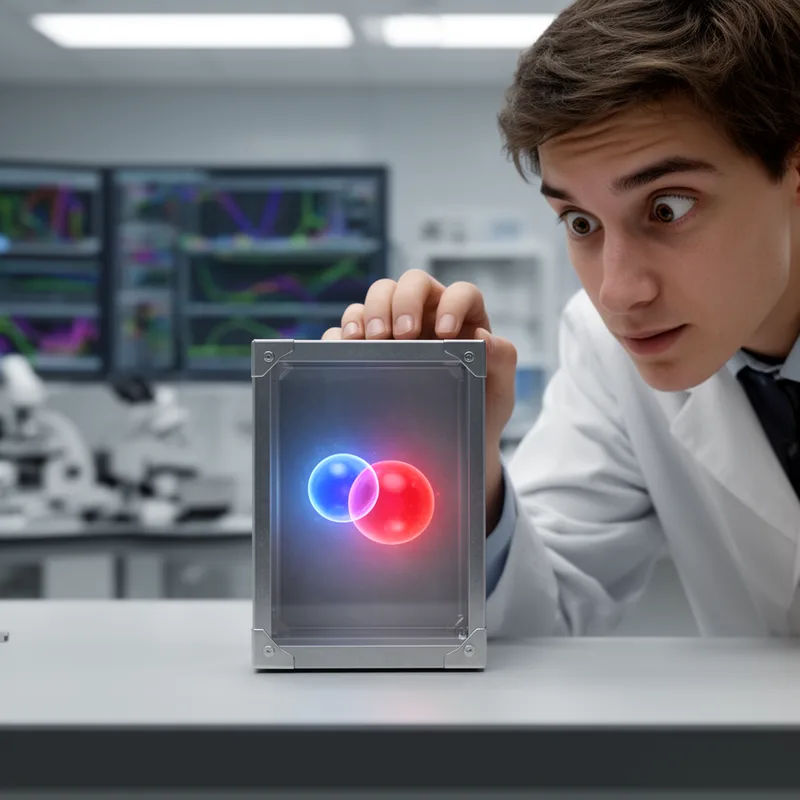
- The thought experiment known as Schrödinger's box illustrates how a particle can exist in multiple states until it is observed.
Examples
-
The particles were in a quantum superposition of all the possibilities, just as though the two particles were together in Schrödinger's box.
Academic text (2001) -
Remember that the whole point of Schrödinger's box is that when the lid is on the box, all of the possibilities are amalgamated—the yes and no, the man of courage versus the chicken-heart, success and failure—all are inside the box.
Academic text (2001) -
In the meantime, I had been reading something in another book and decided that I would represent this issue in my own life in terms of Schrödinger's box.
Academic text (2001) -
In Schrödinger's box, the concept of superposition demonstrates that an unobserved particle is both alive and dead at the same time.
-
According to the theory of Schrödinger's box, reality can encompass all possibilities until a measurement is made.
Surface Forms
Morphology
Schrödinger's + box
The element 'Schrödinger's' is a proper name with no independent lexical meaning that would cue the concept of quantum superposition to a B1 learner, and 'box' only denotes a physical container. The specific sense (a thought experiment where a system is in multiple states until observed) cannot be derived from the constituents without prior cultural or scientific knowledge, so the expression is opaque to most learners.
Etymology
Schrödinger's box comes from a famous imagined experiment by scientist Erwin Schrödinger: a box with a cat inside that, in the story, is both 'alive' and 'dead' until someone opens the box. So, people use Schrödinger's box to describe a situation where the result is 'unknown' or seems to be 'both ways' until someone looks.

