
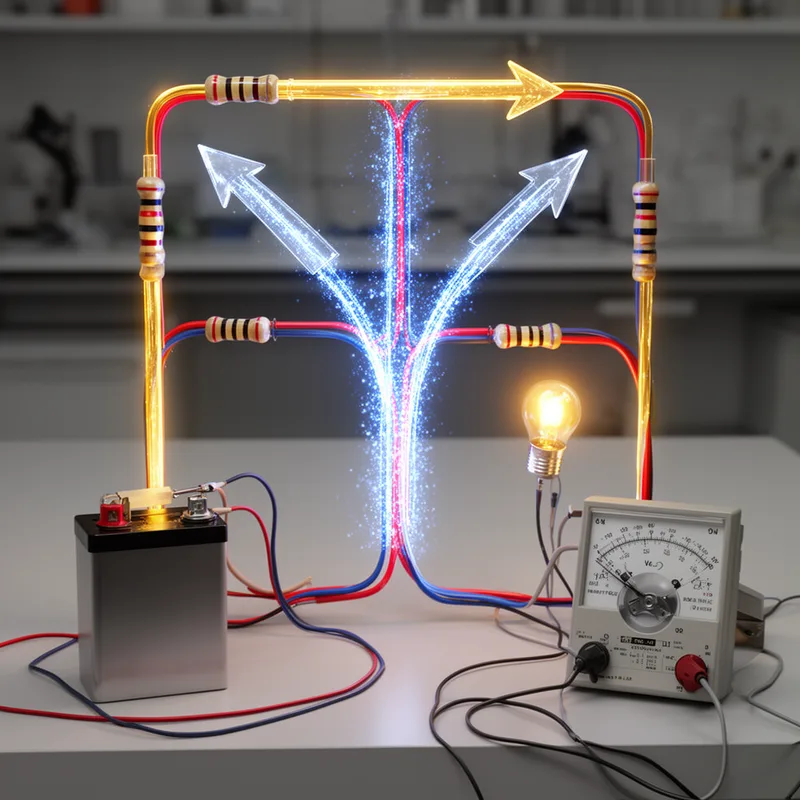
Kirchhoff's laws


 1
7.2
- noun
- /ˈkɪrkhɔːf's lɔːz/
- Specialized
- When applying Kirchhoff's laws, remember that the sum of the voltages in a closed circuit loop must equal zero.
Examples
-
Using Kirchhoff's laws, we can determine the current through each resistor in the circuit.
-
According to Kirchhoff's laws, the total current entering a junction equals the total current leaving it.
-
Electrical engineers often rely on Kirchhoff's laws to analyze complex networks.
-
The physics exam required us to apply Kirchhoff's laws to solve circuit problems.
-
The engineer applied Kirchhoff's laws to analyze the circuit.
-
Using Kirchhoff's laws, we can calculate the total current flowing into and out of the circuit junction.
-
In analyzing electric circuits, understanding Kirchhoff's laws is essential for applying the correct principles.
Surface Forms
Morphology
Kirchhoff's + law
The form is compositional in that it is a possessive proper name + 'laws', so a learner who knows 'law' can infer these are rules or principles associated with a person named Kirchhoff. However, the specific content (that they concern electric circuits and the particular current/voltage rules) cannot be derived from the constituents alone and requires subject knowledge or prior exposure.
Etymology
Kirchhoff's laws are named after the scientist Gustav Kirchhoff, and a simple picture helps you remember them: imagine electric flow like water, so at a junction all the currents that come in must go out, and if you walk around a closed loop you finish at the same level so the total 'voltage' change is zero. That's why the laws tell us that 'current' in equals 'current' out and that 'voltage' changes around a circuit add to 'zero'.