

Kepler's second law
- noun
- /ˈkɛplərz ˈsɛkənd lɔ/
- Specialized
- The changing speed of a planet as it travels around the Sun can be explained by Kepler's second law.
Examples
-
According to Kepler's second law, planets move faster when they are closer to the sun in their orbit.
-
Astronomers use Kepler's second law to calculate how long it takes a planet to travel certain sections of its orbit.
-
According to Kepler's second law, planets move faster when they are closer to the sun.
-
Did you learn about Kepler's second law in your astronomy class?
-
According to Kepler's second law, planets move faster when they are closer to the sun.
-
The motion of Mars around the sun perfectly exemplifies Kepler's second law of planetary motion.
-
In astronomy class, we learned that Kepler's second law explains how a planet covers equal areas in equal times.
Synonyms
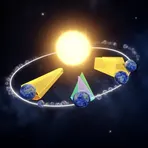
A rule that a line from a planet to the sun covers equal areas in equal times
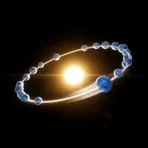
A rule that a planet moves faster when closer to the sun and slower when farther away
Surface Forms
Morphology
This is a proper-name label for a specific scientific principle: knowing 'Kepler's', 'second' and 'law' yields only 'the second law associated with Kepler' and does not allow a learner to derive the substantive content about area-sweeping and orbital speed without domain knowledge. Because the specific meaning requires prior knowledge of Kepler's laws rather than composition of the constituents, it is not transparent to a B1 learner.
Etymology
Kepler's second law gives a simple picture: imagine a straight line from the Sun to a planet that draws slices of space as the planet moves, and that line must make 'equal areas' in 'equal times', so when the planet is nearer the Sun the slice is narrower and the planet has to go faster to cover the same area. That's why the law means planets 'move faster' when they are closer to the Sun.

