
Kepler's first law


 1
7.6
- noun
- Specialized
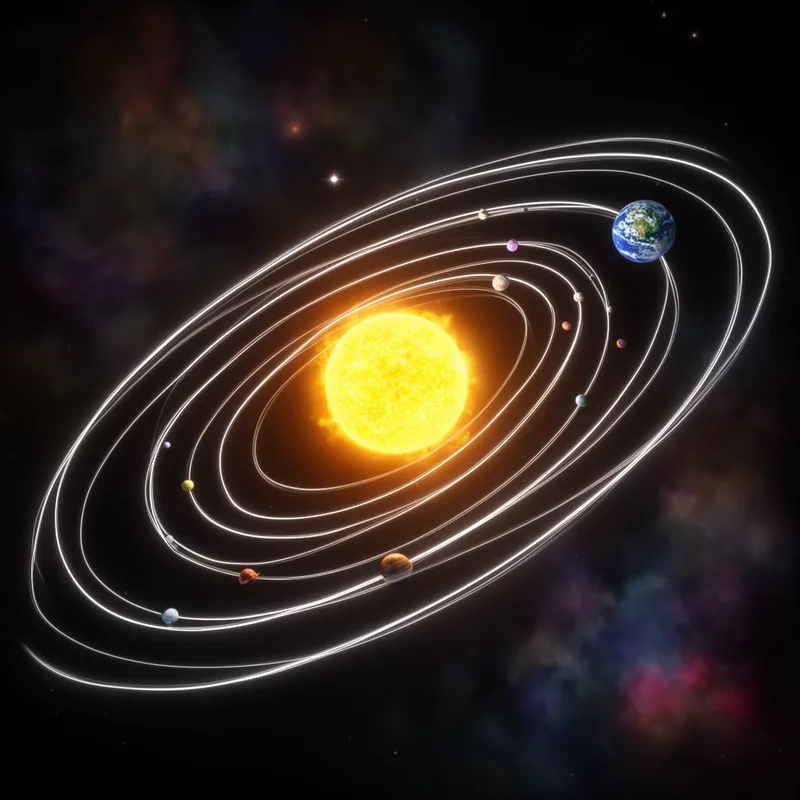
- According to Kepler's first law, planets orbit the Sun in elliptical paths, which changed our understanding of the solar system.
Examples
-
According to Kepler's first law, planets move in elliptical orbits.
-
The shape of Earth's orbit, according to Kepler's first law, is a slightly flattened ellipse.
-
Astronomy students must memorize Kepler's first law when learning about planetary motion.
-
Because of Kepler's first law, we know that the Sun is not at the center of a planet's orbit.
-
Did you know that Kepler's first law was published in 1609?
-
Kepler's first law explains that the orbit of each planet is an ellipse, with the Sun located at one of its foci.
-
Astronomers still refer to Kepler's first law when discussing the elliptical orbits of planets around the Sun.
Surface Forms
Morphology
The phrase transparently indicates a scientific law attributed to Kepler and that it is the first of his laws, so a learner who knows the constituents will recognize it as ‘Kepler’s first law’ in form. However, the specific content (that planetary orbits are ellipses with the Sun at one focus) cannot be derived from the words themselves, so the meaning is only partially predictable.
Etymology
Kepler's first law is named after the astronomer Johannes Kepler, who saw that planets move in a slightly flattened circle called an ellipse. He noticed the Sun sits at one 'focus' of that shape, not in the 'center', so the law means a planet's path is an ellipse with the Sun at one 'focus'.