

Hirschsprung's disease
- noun
- /ˈhɪrʃsprʊŋz dɪˈziːz/
- Specialized
- The newborn was diagnosed with Hirschsprung's disease after experiencing severe constipation and abdominal swelling.
Examples
-
Children with Hirschsprung's disease often experience constipation.
-
Surgery is often required to treat Hirschsprung's disease and restore normal bowel function.
-
Early detection of Hirschsprung's disease can greatly improve outcomes for affected children.
-
Is Hirschsprung's disease hereditary?
-
Early detection of Hirschsprung's disease can greatly improve outcomes for affected children.
-
The newborn was diagnosed with Hirschsprung's disease after experiencing severe constipation and abdominal swelling.
-
Surgery is often required to treat Hirschsprung's disease and restore normal bowel function.
Synonyms
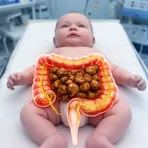
A condition at birth where part of the large intestine lacks nerves and grows too large to move stool
Surface Forms
Morphology
Hirschsprung's + disease
This is an eponymic medical term: the proper name 'Hirschsprung's' supplies no semantic cue about the pathology, and while 'disease' signals an illness, a B1 learner who knows both constituents would not be able to infer the specific congenital absence of nerve cells in the colon or the notion of megacolon. Because the critical information is technical and tied to a name rather than compositional meaning, the expression is opaque to learners.
Etymology
Hirschsprung's disease gets its name from the Danish doctor Harald Hirschsprung, who first described this bowel problem in newborns. He saw that a part of the bowel had no nerve cells and could not push out stool, so the condition was 'named after' him and today the name refers to that birth‑condition that causes a blockage.

