
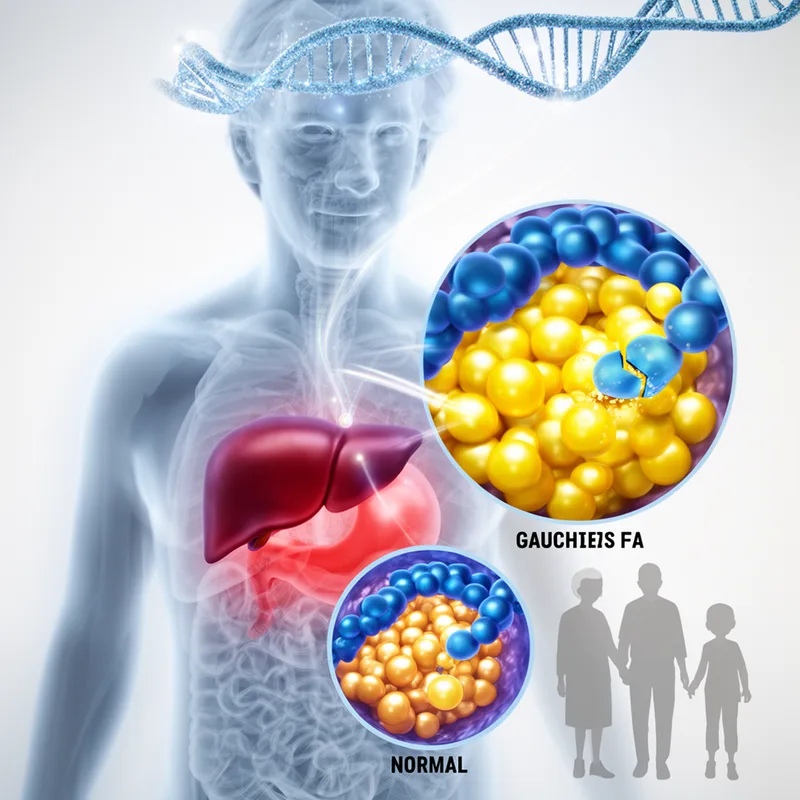
Gaucher's disease


 1
8.0
1
8.0
- noun
- /ɡoʊˈʃeɪrz dɪˈziːz/
- Specialized
- Gaucher's disease is the most common lysosomal storage disorder.
- therapy for Gaucher's disease
- patients with Gaucher's disease
Examples
-
Doctors typically diagnose Gaucher's disease through blood tests that measure the enzyme levels in the body.
-
We studied three men and five women with type 1 Gaucher's disease, aged 25-51 years, of whom five had had splenectomy 3 to 30 years previously.
Academic text (1996) -
The rate of enzyme turnover suggests a rational basis for the use of this therapy in the treatment of Gaucher's disease.
Academic text (1996) -
This expectation has now been realized by Barton and colleagues, who successfully developed enzyme therapy for Gaucher's disease.
Academic text (1996) -
Features of Gaucher's disease include hepatosplenomegaly, bone marrow replacement, skeletal disease, lung infiltration, hypermetabolic state, and rarely, neurological lesions.
Academic text (1996) -
Many people with Gaucher's disease experience symptoms such as fatigue and bone pain due to fat accumulation in their organs.
-
Treatment for Gaucher's disease often involves enzyme replacement therapy to help alleviate symptoms caused by enzyme deficiency.
Synonyms
 12
3.5
12
3.5
A health problem caused by a change in a person's genes that can be passed from parents
 9
4.2
9
4.2
A health problem caused by changes in a person's genes that parents pass on
 3
4.6
3
4.6
A change in a person's genes that causes a disease
 2
3.0
2
3.0
A disease passed from parents to their children through genes
A condition where too much fat builds up in the body's tissues
Surface Forms
Morphology
Gaucher's + disease
The word 'disease' makes it clear to a B1 learner that this is an illness and the possessive proper name 'Gaucher's' signals it is an eponymous medical condition, so learners would grasp it denotes some named disease. However, the specific pathology (a rare inherited enzyme deficiency causing lipid accumulation) cannot be derived from the constituents, so the meaning is only partially predictable.
Etymology
Gaucher's disease is named after the doctor Philippe Gaucher, who first described the illness after finding a patient with a very large spleen. The name joins Gaucher and disease, so it now means the rare disorder passed down in families where fatty substances build up because a key enzyme is missing.