
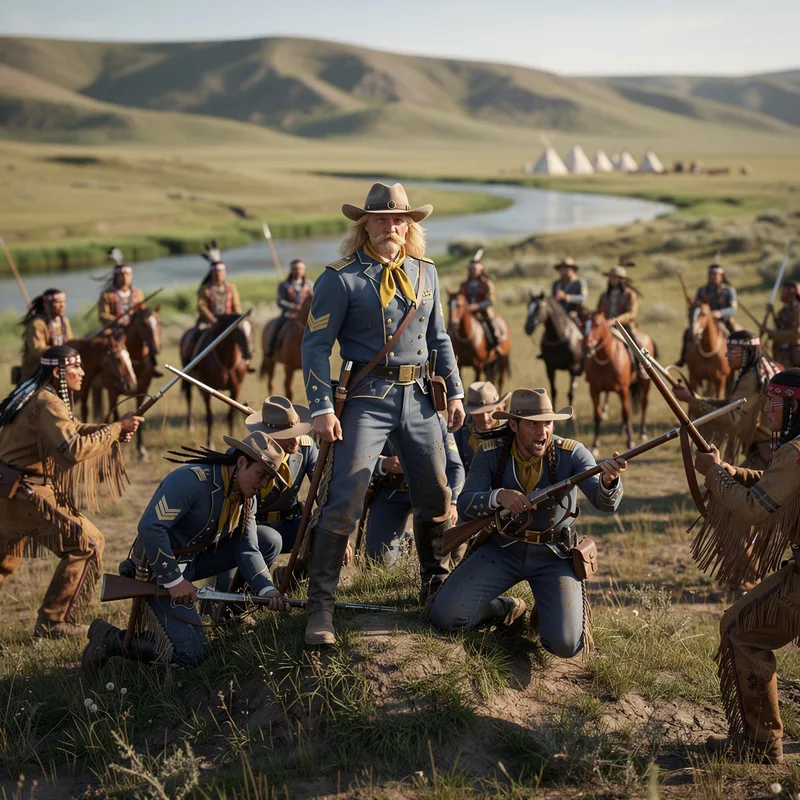
Custer's Last Stand
 1
8.2
1
8.2

- noun
- /ˈkʌstərz læst stænd/
- The Battle of the Little Bighorn, famously known as Custer's Last Stand, marked a significant defeat for the U.S. cavalry.
Examples
-
I did post about Casper, WY, and about Custer's Last Stand, but I hardly even took any photos after that.
Blog text (5) -
BUT YOU KNOW THAT PAINTING OF CUSTER'S LAST STAND YOU'RE SO CRAZY ABOUT?
-
Ladies and gentlemen, this is Custer's Last Stand.
-
It's like Custer's Last Stand.
-
What was the best thing about Custer's Last Stand?
Blog text (32) -
Custer's last stand, was it?
-
All of the survivors meet in the middle of the mall and prepare for Custer's last stand.
Fiction book (2002) -
My name is Jack Crabb, and I am the sole white survivor of the Battle of Little Bighorn, popularly known as Custer's Last Stand.
-
At Little Bighorn, much of the mystery of "Custer's Last Stand" has been dispelled through painstaking archaeological reconstruction of the progress of the battle, based on the distinctive patterns of U.S. Army and Native American projectiles.
Academic text (2007) -
In history class, we learned about Custer's Last Stand and its impact on Native American history.
Synonyms
 1
8.3
1
8.3
A famous 1876 battle in Montana where Custer and his troops were defeated by Native American tribes


 1
6.9
1
6.9
A 1876 battle in Montana where United States soldiers led by Custer lose to Sioux and Cheyenne warriors

An 1876 battle in Montana where General Custer's soldiers were defeated by Sioux and Cheyenne
Surface Forms
Morphology
Knowing 'last' (final) and 'stand' (an act of resisting) lets a learner infer a general sense of a final act of resistance associated with someone named Custer, so the compositional relation is partly clear. However, the phrase refers to a specific historical battle and the proper-name 'Custer' does not make that event predictable from the parts, so full understanding (the 1876 Little Bighorn defeat) requires prior cultural/historical knowledge.
Etymology
Custer's Last Stand names a real 1876 battle where General George Custer and his soldiers were surrounded and killed while making a last, brave defence. That strong image of a final, hopeless fight is why people use the phrase today to mean a 'desperate' or 'final' effort.