
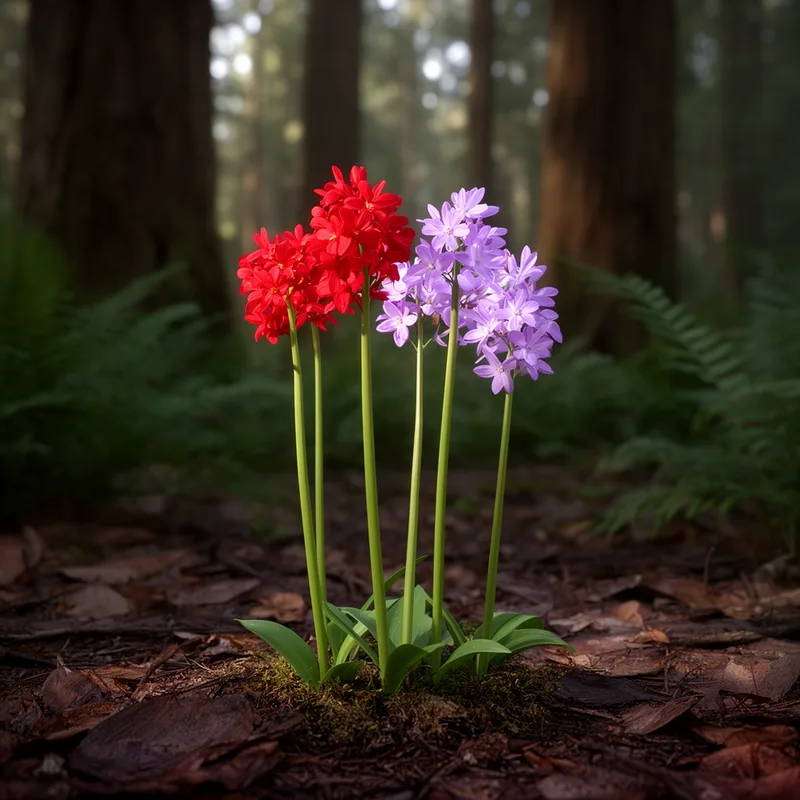
Andrew's clintonia
- noun
- US
- The rare Andrew's clintonia blooms beautifully along forest edges in northern California.
Examples
-
Botanists are working to protect the habitat of Andrew's clintonia from development.
-
Hikers spotted a patch of Andrew's clintonia near the Oregon border.
-
Look at that beautiful Andrew's clintonia!
-
I saw an Andrew's clintonia blooming in the garden.
-
Hikers spotted a patch of Andrew's clintonia near the Oregon border.
-
The rare Andrew's clintonia blooms beautifully along forest edges in northern California.
-
Botanists are working to protect the habitat of Andrew's clintonia from development.
Synonyms

A wild plant with a tall leafless stalk topped by clusters of red flowers

A plant from California and Oregon with a tall stalk topped by red or pale purple flowers
Surface Forms
Morphology
Andrew's + clintonia
This is a straightforward possessive construction: 'Andrew's' (a proper name in genitive form) + 'clintonia' (a plant name), so a learner who knows both constituents will infer it denotes a clintonia associated with Andrew (i.e., a type or instance of the plant). The pattern (possessive/name + noun = named species or variety) is common cross-linguistically, making the meaning transparently derivable from the parts.
Etymology
Andrew's clintonia gets its name from two people: the parts Andrew's and clintonia come from names of people. Andrew's refers to the person Andrew who found or studied the plant, and clintonia was 'named for' a man called Clinton. So the name simply means the clintonia plant linked to Andrew, which is why we use it for this species.

