
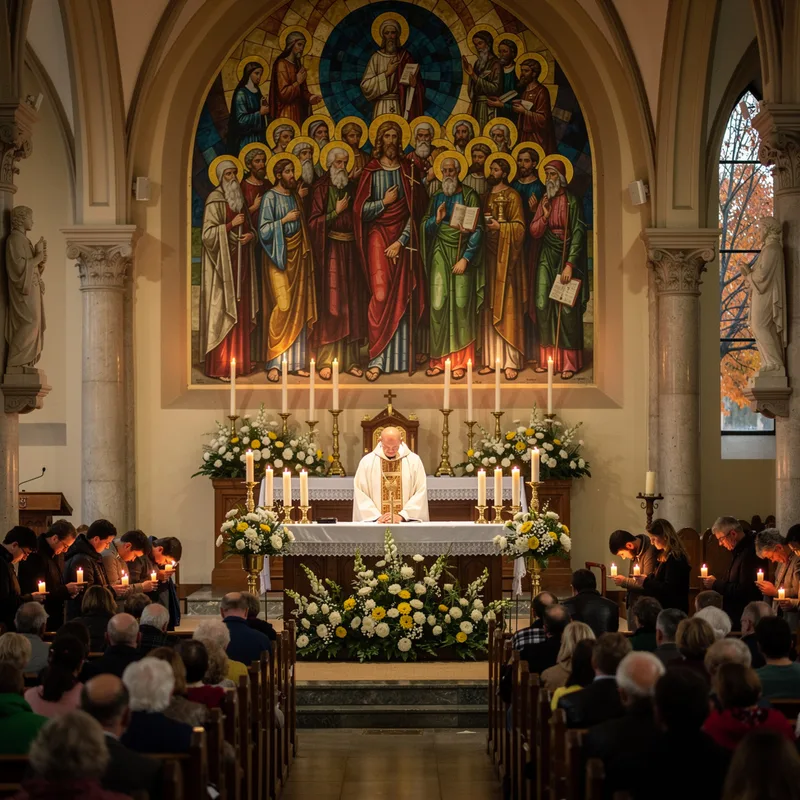
All Saints' Day
 3
4.2
3
4.2

- noun
- /ɔl seɪnts deɪ/
- Last year on All Saints' Day, Timothy O'Malley wrote about the Christian vocation to sainthood.
Examples
-
In some households, November 1st is All Saints' Day.
Blog text (1) -
Throughout Latin America, All Saints' Day and All Souls' Day are treated like a single holiday.
Blog text (7) -
Generally speaking, summer is supposed to begin about Easter, and winter, about All Saints' Day.
Blog text (26) -
In Roman Catholic cultures, Day of the Dead corresponds with All Saints' Day and All Souls' Day.
Blog text (7) -
However, the Day of the Dead celebration remained part of the culture and was incorporated into All Saints' Day festivities.
Blog text (7) -
The Mexican way of celebrating All Saints' Day, Nov. 1, is not at all somber.
Blog text (1) -
A friend who came to visit said that potted chrysanthemums were meant to be taken to graves on All Saints' Day.
Fiction book (1993) -
Early Christians contextualized European winter celebrations into All Saints' Day as a way to remember and honor faithful Christian saints.
Blog text (28) -
Spaniards commemorate Día de los Muertos on All Saints' Day, November 1.
Blog text (7) -
On All Saints' Day, many families attend church services to honor loved ones who have passed away.
Synonyms


 1
9.9
1
9.9
A Christian feast day on November 1 to honor all the saints
A Christian day to honor all saints on November 1

A Christian day on November 1 that honors all saints
Surface Forms
Morphology
The phrase is compositional: 'all' + 'saints' + 'day' straightforwardly yields 'a day for all saints', so a B1 learner who knows the constituent words can infer it denotes a day honoring all saints (even if they may not know the exact date or liturgical details). The same calendrical naming pattern exists in many languages (e.g., Toussaint, Día de Todos los Santos), which supports its predictability across learners.
Etymology
All Saints' Day began when the church chose one day to honor every holy person. Because that day is for all the saints, the name means a special November day to remember 'saints' and often visit graves.