

women's liberation movement
 1
4.4
1
4.4

- noun
- /ˈwɪmɪnz ˌlɪbəˈreɪʃən ˈmuːvmənt/
- The women's liberation movement emerged in the 1960s to advocate for equal rights and opportunities for women.
Examples
-
With the women's liberation movement came shifting standards for flight attendants.
Blog text (29) -
Menstruation, menopause, childbirth, and sex from a woman's viewpoint: these uniquely female experiences were embraced as subjects beginning with the women's liberation movement of the late 1960s.
Academic text (2000) -
The women's liberation movement was exploding.
-
As discussed earlier, consumerism provided girls with space to explore their subjectivity, and this also held for activists of the women's liberation movement.
Academic text (2014) -
At the height of the Vietnam era, the women's liberation movement and the antiwar movement were cross-pollinating, forming hybrid ideologies.
Blog text (8) -
The period when this manga was serialized saw the development of the women's liberation movement in Japan, and activists were women marginalized in the new left movement, like their counterparts in other parts of the world.
Academic text (2014) -
Influenced by the women's suffrage movement in the United States, China in the 1920s experienced an active women's liberation movement, calling for rebellion against the traditional male-dominated culture.
Academic text (1996) -
Although in past years there was a distinct lack of involvement in the women's liberation movement by Black women, now middle-class Black women are becoming more sensitive to the obstacle of sexism as racial barriers begin to fall.
Academic text (1990) -
Many activists joined the women's liberation movement to fight against gender discrimination and promote equality.
-
The women's liberation movement played a crucial role in changing societal perceptions about women's roles in the workplace.
Synonyms
 141
3.9
141
3.9
Support for equal rights and chances for women
 11
3.5
11
3.5
People who work to get equal rights and chances for women
 3
4.6
3
4.6
A movement for equal rights and opportunities for women
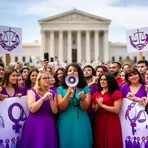
A social movement that works for women's rights and gender equality
Antonyms
Surface Forms
Morphology
women's + liberation + movement
The meaning is transparently built from the constituents: 'women's' (relating to women) + 'liberation' (freedom from oppression) + 'movement' (organized collective action), so the phrase literally denotes organized efforts for women's freedom/rights. This composition is cross-linguistically common and follows normal noun-modifier patterns, so a B1 learner who knows the constituent words will readily infer the MWE's meaning.
Etymology
Women's liberation movement comes from women in the 1960s and 1970s who joined together to win liberation ('freedom') from unfair roles and limits and to form a movement (a group working for change). They held protests, meetings and wrote books to demand equal rights, so today the phrase means 'campaigns to get equal rights and chances for women'.