
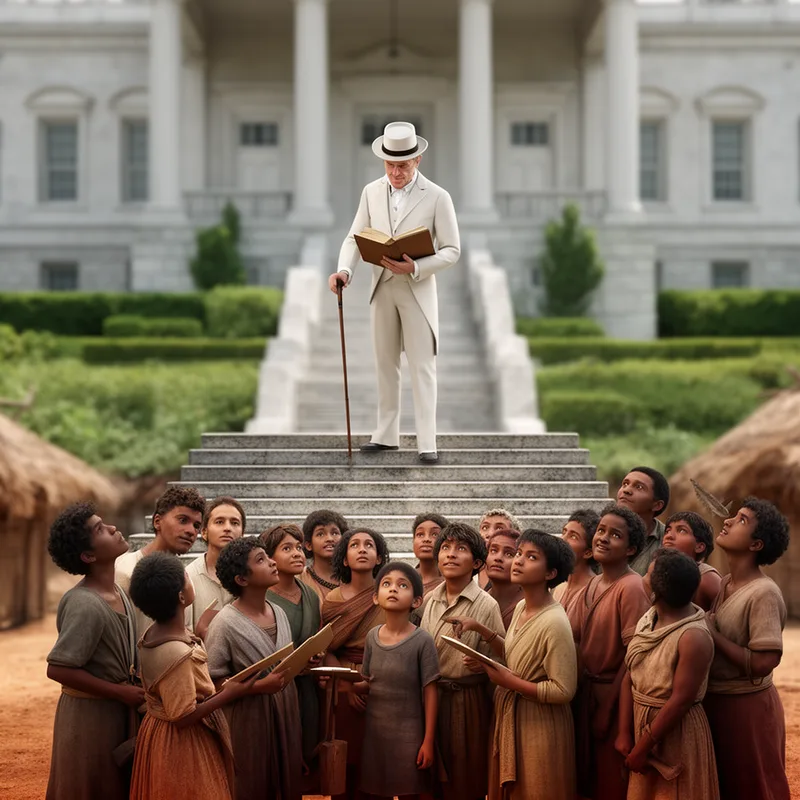
white man's burden


 1
9.9
1
9.9
- noun
- /waɪt mænz ˈbɜrdən/
- Offensive
 :
carga del hombre blanco
:
carga del hombre blanco
- During the colonial era, many Western leaders justified their actions by invoking the concept of the white man's burden, believing they had a duty to civilize non-white populations.
Examples
-
In each case, the control of the subordinate class is thought justifiable and beneficial -- hence the force of doctrines ranging from "white man's burden" and noblesse oblige to technocracy and economic development.
Academic text (1992) -
This "white man's burden," bringing the Anglo-Saxon "gift for governing" to the barbarians of the world, has been a recurring theme in literature (Horsman 1981, 247).
Academic text (2013) -
I mean, this is the new white man's burden.
-
But that's the white man's burden.
-
The sober truth was that the white man's burden of winning the West was crushing global folly.
Academic text (2000) -
Thirdly, perhaps I'm reading into this, but the idea that they need to save these children from themselves, from their culture, makes me think about the white man's burden.
Blog text (7) -
Although I agree that the United States is relatively benign, the notion that it has taken up a kind of global-age "white man's burden" strains belief.
Academic text (2000) -
This came at a time when racism and social bias were rife, and people spoke without irony of how the millennia-old cultures of India and China were "savage" and that they were obliged to take up the "white man's burden."
Academic text (2009) -
Internationally, the "scramble for Africa" parceled out the "dark continent" among rival European powers, while the U.S. shouldered its own white man's burden in the far-off Philippines.
Academic text (1992) -
As early as the turn of the century, they were eager for us not only to help them out financially, but to continue on their behalf the destiny of the Anglo-Saxon race: to bear with courage the white man's burden, as Rudyard Kipling not so tactfully put it.
Academic text (1992)
Surface Forms
Morphology
Although the words 'white', 'man', and 'burden' have clear literal meanings, the phrase refers to a specific historical and ideological justification for colonialism that cannot be inferred from the parts alone. This is a culturally and historically specific metaphorical expression whose political meaning would be opaque to a B1 learner who only knows the constituent words.
Etymology
White man's burden comes from a poem by Rudyard Kipling that pictured a heavy burden white people said they had to carry to 'civilize' and rule other peoples. That's why the phrase now means the idea that white people claimed a 'moral duty' to rule others, and it was often used to justify unfair treatment of non-white people.