
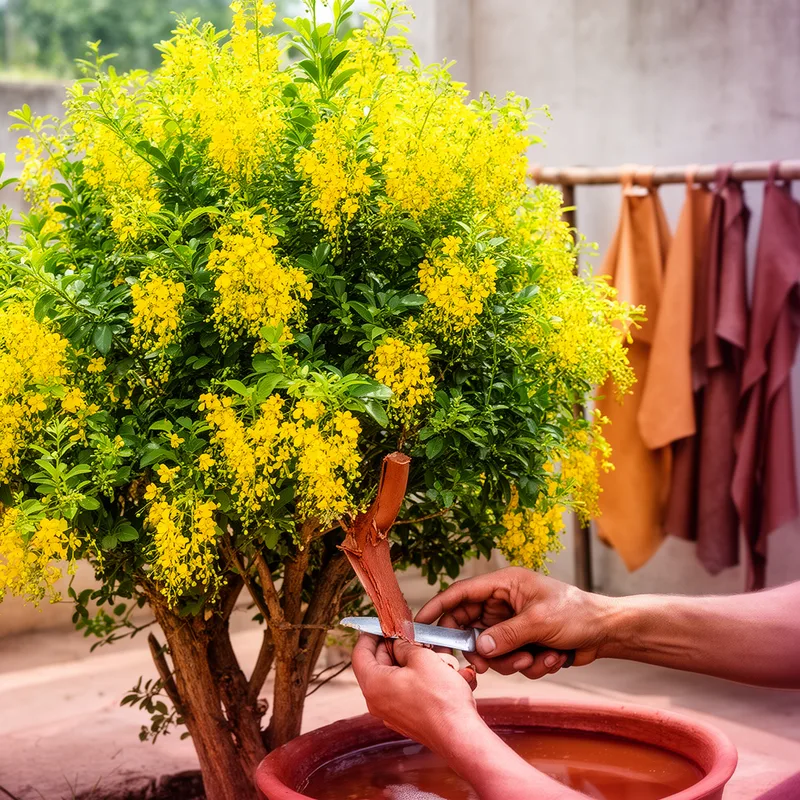
tanner's cassia
- noun
- Indian
- The bark of tanner's cassia is highly valued in the leather industry.
Examples
-
Traditional practices often use tanner's cassia as a source of natural dye and tanning agent.
-
Gardeners admire tanner's cassia for its vivid display of yellow flowers.
-
The tanner's cassia plant thrives in tropical climates.
-
Farmers in India often cultivate tanner's cassia for its bark.
-
Many tanners prefer tanner's cassia because its bark makes high-quality leather.
-
In India, tanner's cassia is used not only for tanning but also for its stunning yellow flowers.
-
The vibrant yellow flowers of tanner's cassia attract numerous pollinators in the garden.
Synonyms

An evergreen shrub from India with bright yellow flowers whose bark people use to make leather
A small Indian bush that keeps its leaves all year and has bright yellow flowers and bark used for tanning
An Indian evergreen shrub with bright yellow flowers whose bark tans leather
Surface Forms
Morphology
tanner's + Cassia
The phrase is a straightforward possessive compound: 'tanner's' (a person who tans hides) + 'cassia' (a genus of shrubs), so the meaning — a cassia associated with or used by tanners (i.e., used in tanning) — is directly inferable from the parts. This compositional possessive pattern is common cross-linguistically and would be clear to a B1 learner who knows both constituents.
Etymology
Tanner's cassia gets its name from the plant's use in making leather. A 'tanner' is someone who makes leather, and they used the bark of this cassia to soak hides and add color, so the name points to the shrub whose bark is used for tanning and dyeing.

