
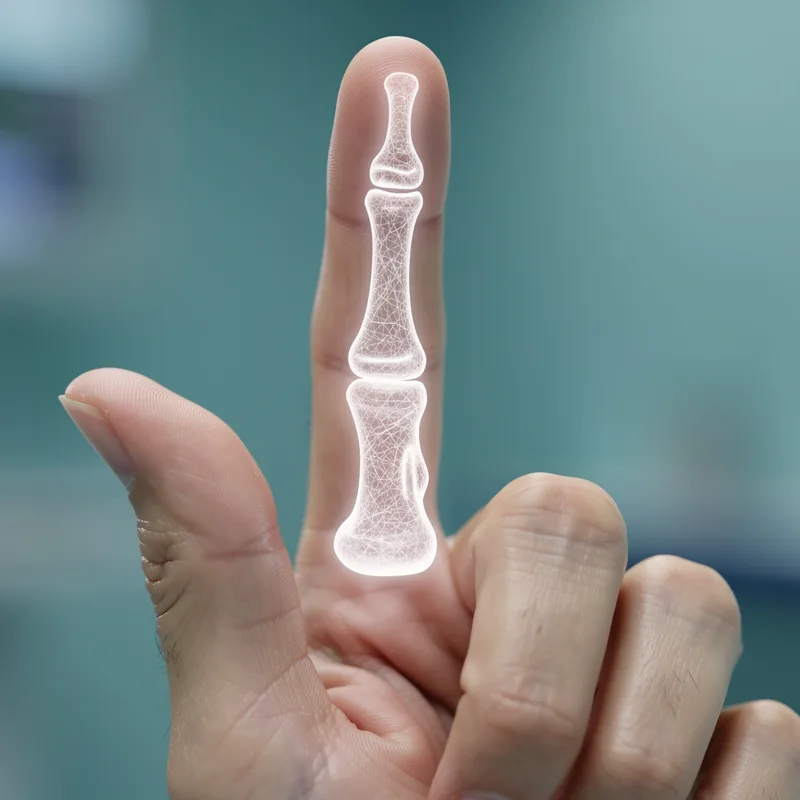
phalanx
 1
8.6
1
8.6

- noun
- /ˈfeɪlæŋks/
- Specialized
- A 17-year-old woman presented to another hospital with a type II fracture of the middle phalanx of the index finger (Figure 5A).
- proximal phalanx
- middle phalanx
- phalanx fracture
Examples
-
More often, however, the polydactyly is more complex and involves the distal or proximal phalanx of the toe.
Academic text (2005) -
A four-year-old girl presented to the hospital with a type III fracture of the middle phalanx of the little finger (Figure 1A).
Academic text (2012) -
The fifth metacarpal and phalanx are the most frequently injured hand bones (see Figure 17).
Academic text (2006) -
A 19-year-old man presented to another hospital with a type II fracture of the proximal phalanx of the thumb.
Academic text (2012) -
An x-ray at four weeks (Figure 1C) showed evidence of healing and periosteal reaction in the middle phalanx.
Academic text (2012) -
Therefore, the midpoint distance represents one-half of the dorsal to palmar articular surface of the middle phalanx base.
Academic text (2015) -
A 10-year-old boy presented to another hospital with a type II fracture of the proximal phalanx of the index finger (Figure 2A).
Academic text (2012) -
The surgeon repaired the fracture in the proximal phalanx of the little finger.
-
During the examination, the doctor noted the alignment of the phalanx joints in her hand.
-
After the injury, he experienced pain in the distal phalanx of his index finger.
Synonyms
 8
8.2
8
8.2
A small bone in a finger or toe
Surface Forms
Etymology
Phalanx comes from an old Greek word meaning 'finger', so each small bone in a finger or toe is called a phalanx, and the group of these bones is often called 'phalanges'.