
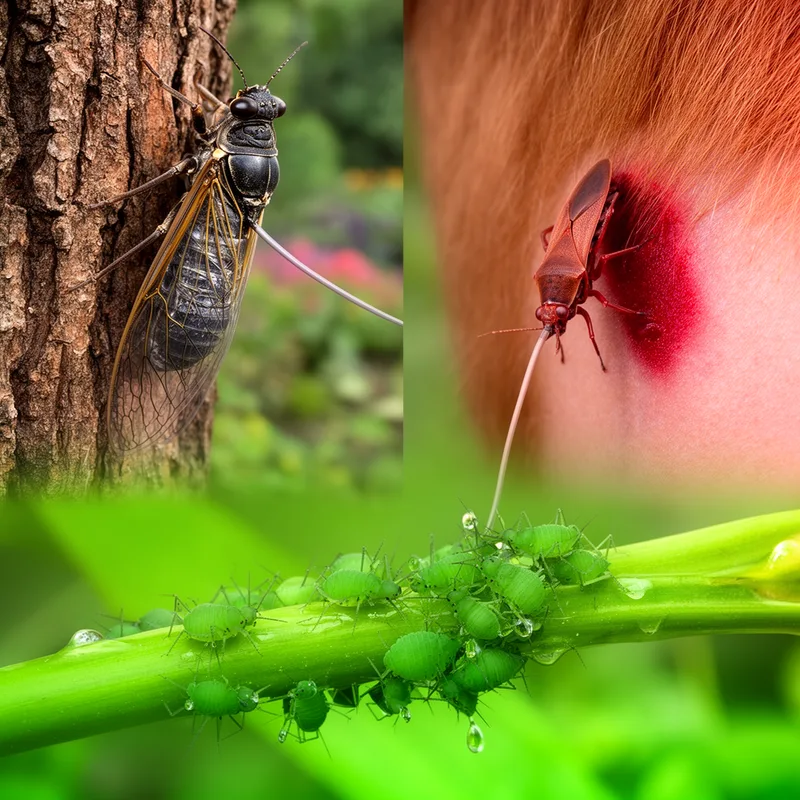
Hemiptera
- noun
- /ˈhɛmɪˌptərə/
- Specialized
- All of the Hemiptera assigned to the high-impact list were in the Sternorrhyncha, which includes adelgids, aphids, scales, and psyllids.
- order Hemiptera
Examples
-
Leafhoppers (Cicadellidae) were also well represented at 42 species, comprising 22% of the Hemiptera.
Academic text (2010) -
Representation of insects by taxa: sap-feeding insects in the order Hemiptera dominated the list of nonindigenous forest insects with 189 species, accounting for 41.5% of all species (Table 2).
Academic text (2010) -
Insecta Hemiptera, of the suborder Auchenorrhyncha!
-
These insects are also in the group of "true bugs" (Hemiptera) and are predatory, but they look nothing like beetles.
Academic text (1993) -
Furthermore, Strode (2009) observed that hackberry psyllids (Order Hemiptera) may be an important food resource for migrating songbirds early in spring.
Academic text (2016) -
Aphids, adelgids, and scale insects in the suborder Sternorrhyncha accounted for 69% of the Hemiptera and 28.6% of all species on the complete list.
Academic text (2010) -
Backswimmers are aquatic insects that may be mistaken for beetles, but are, like the water boatmen, really in the order of "true bugs" (Hemiptera).
Academic text (1993) -
Therefore, in plots subjected to root herbivory, the community of foliar-feeding Hemiptera was more diverse, and plant species richness and cover were lower than in soil insecticide-treated plots (Masters and Brown 1997).
Academic text (2000) -
Aphids, classified under the order Hemiptera, are known for their ability to reproduce quickly.
-
Many insects in the order Hemiptera, such as cicadas and leafhoppers, have adapted to various environments.
Surface Forms
Morphology
Hemiptera = hemi- + ptera (opaque) = hemi + ptera
A learned taxonomic name built from Greek combining forms ('hemi-' + '-ptera'); the meaning 'half-wing' is not obvious to an average B1 learner without knowledge of these scientific combining forms.
Etymology
Hemiptera comes from Greek parts hemi- 'half' and ptera 'wings', and the hemi- part is the same as in hemisphere. The insects were named for their front wings that are partly hard and partly soft, so their name means 'half-wings' and now refers to the group of bugs that have those wings and piercing and sucking mouthparts.

