
commedia dell'arte
 3
9.9

- noun
- /kəˈmeɪdiə dɛlˈɑrteɪ/
- Their theater, which they call la commedia dell'arte.
Examples
-
While the part of Pantalone in this Polish version of the commedia dell'arte was well performed by either Uncle Sam or John Bull, the role of Columbine was more diversified and was assigned alternatively to different countries and people.
Academic text (1990) -
These often resemble the principles of commedia dell'arte.
Academic text (1990) -
Commedia dell'arte.
-
These figures, as Donald Posner has shown, are not standard players from the commedia dell'arte, although some of them, such as Metzetin, Scaramuccia, and Scapino, have namesakes in the impromptu theater.
Academic text (2001) -
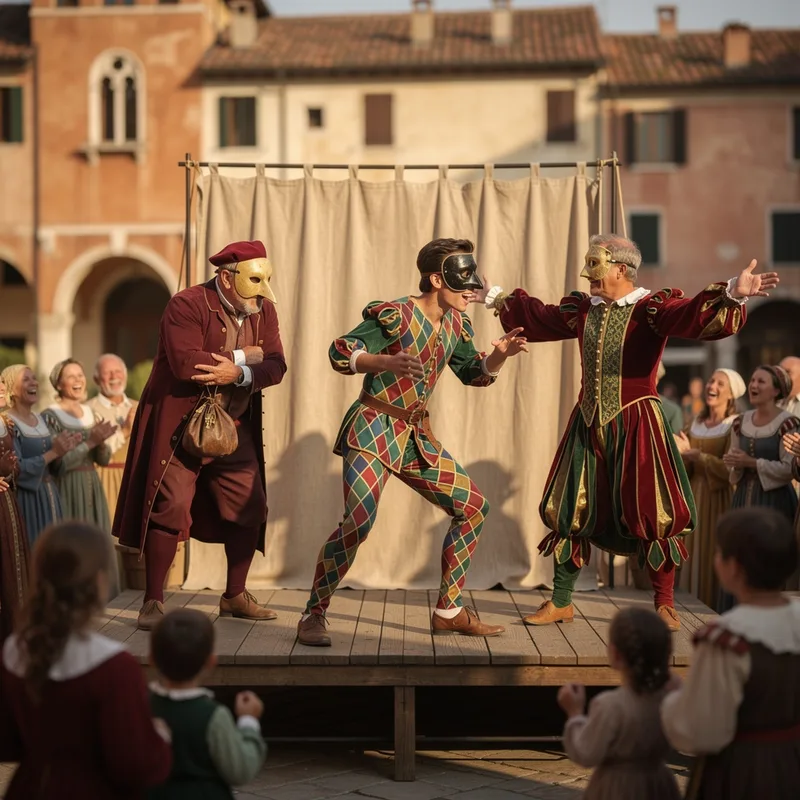
The group performed a lively commedia dell'arte show featuring familiar characters like Harlequin and Columbine.
-
Many theater students learn the principles of commedia dell'arte to enhance their improvisational skills.
-
During the festival, audiences enjoyed a thrilling performance of commedia dell'arte that showcased classic Italian humor.
Surface Forms
Morphology
commedia + dell'arte
This is an Italian lexicalized term referring to a specific historical theatrical genre; its full meaning (improvised performances with stock characters from 16th–18th‑century Italy) is cultural and cannot be predicted from the surface words. The constituents are Italian and not transparently interpretable by an average B1 English learner, so the sense is not derivable without prior exposure or cultural knowledge.
Etymology
Commedia dell'arte comes from Italian, where commedia means 'comedy' and dell'arte means 'of the art' or 'of the artists'. It named groups of actors who wore masks, used the same funny characters, and often made up their lines in short scenes, so the phrase now means that lively style of theatre where actors created the words as they performed.