
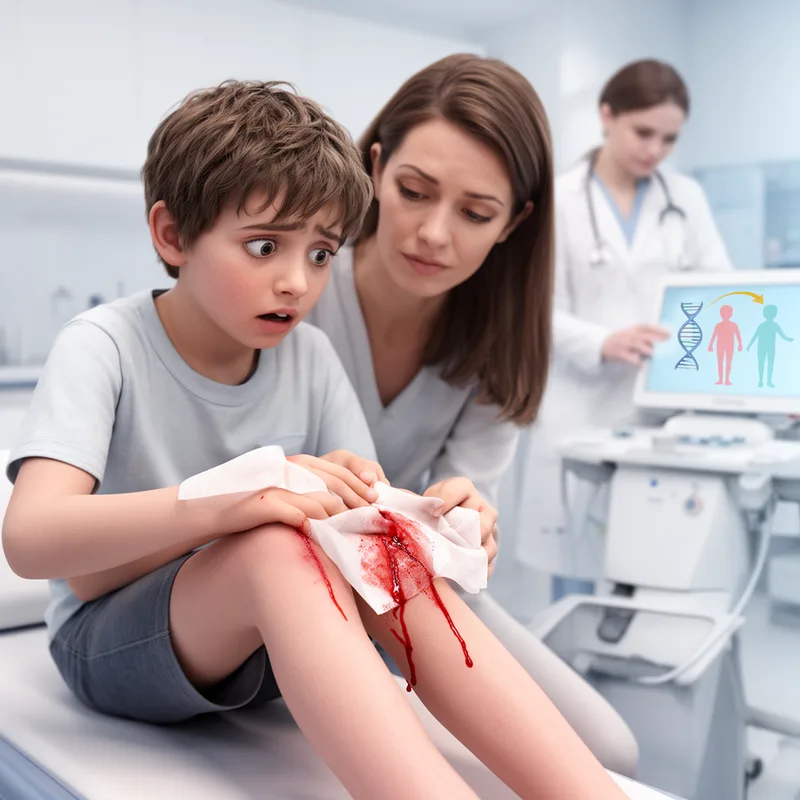
bleeder's disease
- noun
- /ˈblidərz dɪˈziz/
- Specialized
 :
hemofilia
:
hemofilia
- The young boy was diagnosed with bleeder's disease after experiencing prolonged bleeding from a minor cut.
Examples
-
Families with a history of bleeder's disease often seek genetic counseling before having children.
-
Because bleeder's disease is inherited, it is important to inform your doctor if there is a family history.
-
He was diagnosed with bleeder's disease at a young age.
-
Many people with bleeder's disease require special medical care.
-
The young boy was diagnosed with bleeder's disease after experiencing prolonged bleeding from a minor cut.
-
Families with a history of bleeder's disease often seek genetic counseling before having children.
-
Because bleeder's disease is inherited, it is important to inform your doctor if there is a family history.
Synonyms

 7
6.7
7
6.7

A condition you are born with where blood keeps bleeding after a cut

An inherited condition where a missing blood protein makes bleeding last longer, mainly in boys and men
Surface Forms
Morphology
bleeder's + disease
The phrase is compositionally built from 'bleeder' (someone who bleeds) + 'disease' (a medical condition), so a learner who knows those words would reasonably infer it refers to a medical condition causing excessive bleeding. They might not deduce the specific congenital/inherited details, but the basic meaning (a bleeding-related disease) is directly predictable from the parts.
Etymology
Bleeder's disease comes from the old name bleeder for someone who bled a lot, with disease added to mean the health problem that caused those bleeds. So, the name points to a condition that causes 'excessive bleeding' and is often 'inherited' within families.