

to bite one's lip
- idiom
- Informal
- He always bites his lip when he's trying to hold back his emotions.
Examples
-
I bite my lip to stop myself making a noise.
-
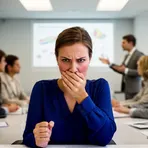
She had to bite her lip to keep from laughing during the serious meeting.
-
Okay, now bite your lip like this, sort of like...
-
Hey, just grab a hold of something, bite your lip and give it hell.
-
You don't have to bite your lip now.
-
Knew it the second you walked inside and set your eyes on him, biting your lip the way you do.
-
Whenever she feels nervous, she tends to bite her lip to suppress her anxiety.
Synonyms

 5
7.0
5
7.0

To take back words you said
 3
5.4
3
5.4
To stay silent to avoid saying something rude
 1
6.1
1
6.1
Stop yourself from saying something you want to say because it would be rude

To stop yourself from making a sound when something is funny

To keep quiet on purpose and not tell others

To keep quiet and not tell others about something
Antonyms


How Restrained

Surface Forms
Morphology
The phrase is motivated by a literal, easily visualized action (biting one’s lip) that signals holding back speech or emotion, so a learner who knows 'bite' and 'lip' can plausibly infer the physical basis and likely communicative function. However, the conventionalized pragmatic meaning (suppressing laughter, emotion, or words) is an extension of the literal action and may not be fully predictable without exposure, so it is only partially transparent.
Etymology
Bite one's lip comes from the real action of gently biting your lip with your teeth to hold back a laugh, a cry, or the words you want to say. So, it now means 'to stop yourself from laughing, speaking, or showing strong feelings'.