
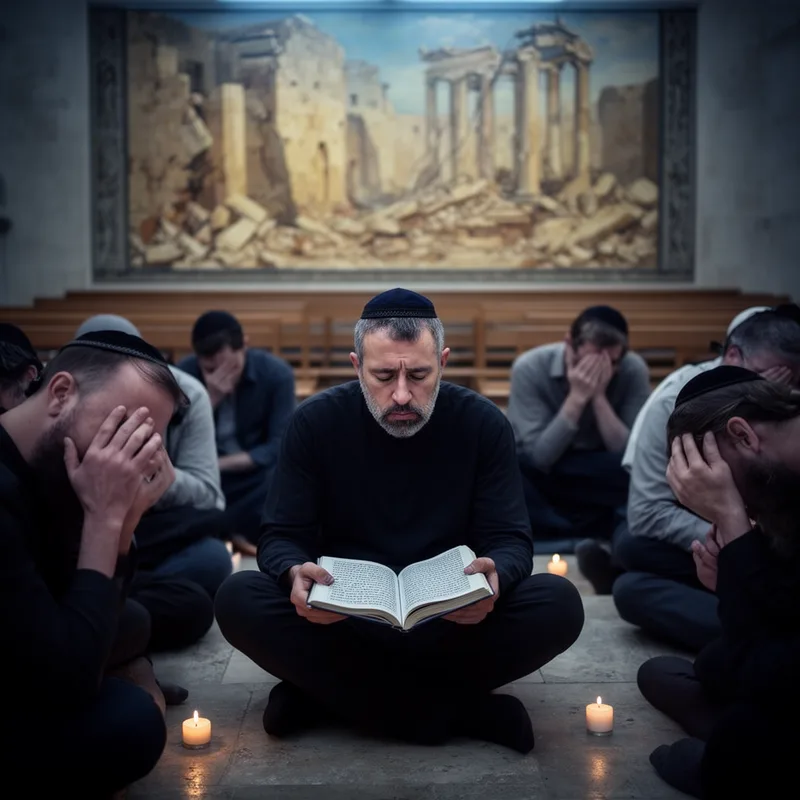
Tishah b'Av
- noun
- /ˈtɪʃə bʌʌv/
- Jews around the world join together in mourning on Tishah b'Av, reflecting on the destruction of the ancient temples.
Examples
-
Each year, many Jews observe Tishah b'Av by fasting and reading from the Book of Lamentations.
-
Many Jews observe Tishah b'Av with fasting.
-
On Tishah b'Av, synagogues often hold special services to commemorate the tragedies of Jewish history.
-
Is Tishah b'Av a day of mourning?
-
Each year, many Jews observe Tishah b'Av by fasting and reading from the Book of Lamentations.
-
Jews around the world join together in mourning on Tishah b'Av, reflecting on the destruction of the ancient temples.
-
On Tishah b'Av, synagogues often hold special services to commemorate the tragedies of Jewish history.
Synonyms

A major Jewish fast day when people mourn the destruction of the temples in Jerusalem
A day when Jewish people fast and mourn the destruction of the First and Second Temples in Jerusalem

A major Jewish fast on the ninth day of Av that remembers the destruction of the temples in Jerusalem

A major Jewish day when people do not eat or drink to remember when the temples in Jerusalem were destroyed

A Jewish fast day to remember the destruction of the temples in Jerusalem

A day when Jewish people fast and mourn the destruction of the ancient temples in Jerusalem
A major Jewish day when people do not eat to remember when the temples were destroyed in Jerusalem
Surface Forms
Morphology
Tishah + b'Av
This is a transliterated proper name for a specific Jewish fast day whose meaning depends on cultural and historical knowledge rather than composition of English lexical parts; the constituents 'Tishah' and 'b'Av' are not ordinary English words with transparent meanings. Because the term is an encyclopedic/religious name (not built from predictable English morphemes), a B1 learner who only knows the surface constituents would not be able to derive the event and ritual meaning.
Etymology
Tishah b'Av literally means the 'ninth of Av' in Hebrew, the calendar day when long ago both ancient temples in Jerusalem were destroyed. People mark that day with 'fasting', not eating, and 'mourning', showing deep sadness, so the name now means the yearly Jewish day of sorrow and remembrance.

