
Stevens' law
- noun
- /ˈstiːvənz lɔː/
- Specialized
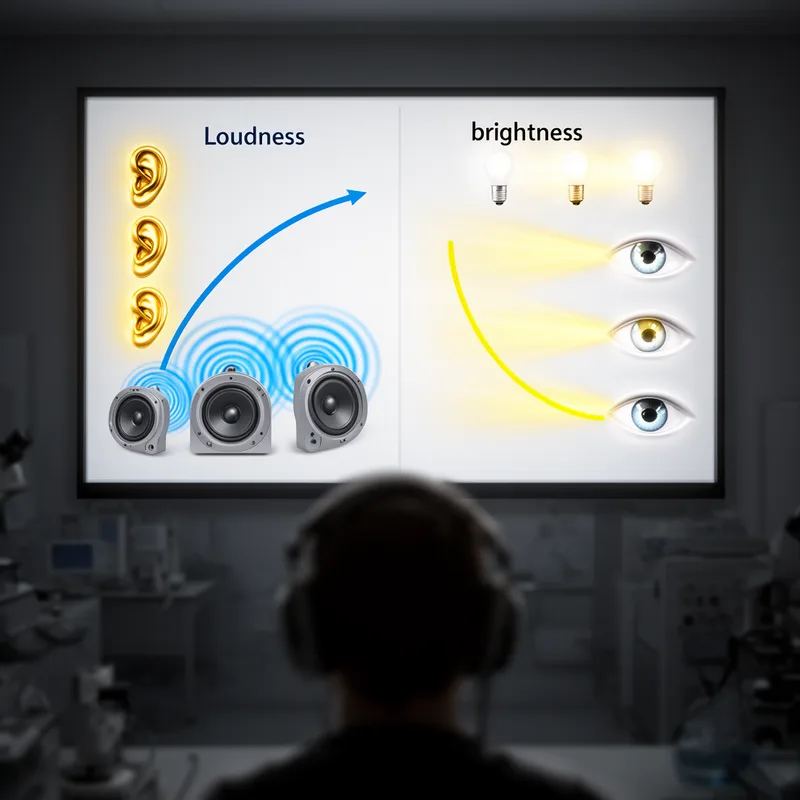
- According to Stevens' law, the relationship between sound intensity and loudness is not linear.
Examples
-
Researchers often compare Stevens' law and Fechner's law in experimental settings.
-
Many psychology textbooks discuss Stevens' law when introducing sensory perception theories.
-
According to Stevens' law, our perception of stimulus intensity varies.
-
Have you studied Stevens' laws in your psychology class?
-
According to Stevens' law, the perceived loudness of a sound increases as its intensity grows.
-
Many researchers reference Stevens' law to explain how we experience different levels of brightness.
-
In sensory studies, Stevens' law is often used to analyze the relationship between stimulus strength and perception.
Synonyms

A rule that how strong something feels grows as a power of its actual strength
Surface Forms
Morphology
Stevens' + law
The phrase transparently signals a named scientific principle because 'law' denotes a general principle and the possessive proper name indicates attribution. However, the specific content (a psychophysical power law) cannot be derived from the constituents alone, so learners can infer its type but not its precise meaning.
Etymology
Stevens' law is named after psychologist S. S. Stevens, who noticed that when you turn up a sound or a light, the way it feels does not grow in a straight line — sometimes a big increase in real strength gives only a small change in how we 'feel' it. That's why Stevens' law helps predict how the real strength of a sound, light, or touch relates to the 'feeling' it gives.

