
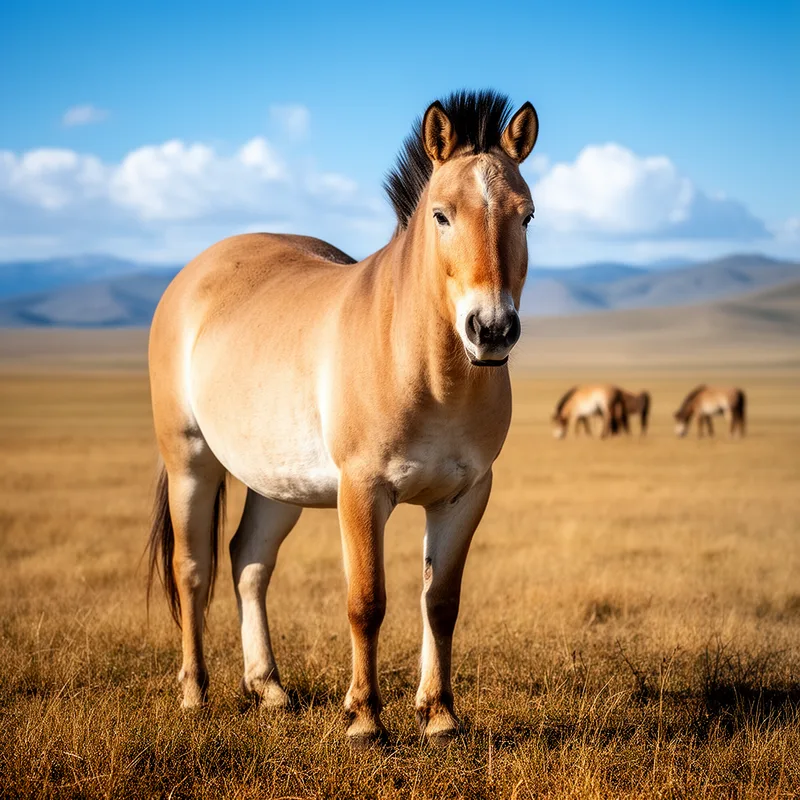
Przewalski's horse


 1
9.9
1
9.9
- noun
- /prəˈzɛwəlskiz hɔrs/
- Conservationists are working hard to protect Przewalski's horses, as they are critically endangered and need urgent preservation efforts.
- domestic and Przewalski's horse
Examples
-
In the early morning, a rare sight was captured when a photographer spotted a stunning herd of Przewalski's horses grazing near a water source.
-
Or subspecies like domestic horses (2n=64) and Przewalski's horse (66) which interbreed.
Blog text (26) -
During our trip to Mongolia, we were thrilled to see a group of wild Przewalski's horses roaming freely in their natural habitat.
Synonyms
A wild horse from Central Asia with a short erect mane and a strong, stocky body, now endangered
A rare wild horse from central Asia with a stocky body and a short upright mane that is now endangered
A rare endangered wild horse from Central Asia that looks like a donkey
Surface Forms
Morphology
Przewalski's + horse
This is a possessive proper-name + noun construction: a learner who recognises the pattern 'X's Y' will transparently infer it denotes a kind of horse associated with (named after) Przewalski. Specific biological facts (wild, endangered, 'last true wild horse') require encyclopedic knowledge, but the basic category 'a type of horse' is directly derivable from the parts.
Etymology
Przewalski's horse is named after the explorer Przewalski, who first showed this rare wild horse to European scientists. That's why the name points to this particular type of wild horse from central Asia.