

Peter's pence
- noun
- /ˈpiːtərz pɛns/
- Every year, Catholic churches collect Peter's pence as a symbol of solidarity with the Pope.
Examples
-
Many Catholics contribute to Peter's pence to support the papal see.
-
The tradition of Peter's pence dates back to the 8th century in England.
-
Some parishioners made generous donations during the annual Peter's pence collection.
-
Many Catholics contribute to Peter's pence every year.
-
Did you donate to Peter's pence this year?
-
Every year, Catholic churches collect Peter's pence as a symbol of solidarity with the Pope.
-
During Mass, the collection for Peter's pence reminds parishioners of their duty to the Church.
Synonyms
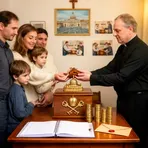
An annual payment Catholic families give to support the pope
Surface Forms
Morphology
Peter's + pence
The components 'Peter's' (possessive) and 'pence' (small coins/money) signal that this is some kind of money associated with Peter, so learners can infer a financial/donation sense from the parts. However, the specific institutional meaning — an annual papal contribution tied to the Pope as successor of Saint Peter — requires cultural or historical knowledge beyond the literal words, making the exact sense not fully predictable from the constituents alone.
Etymology
The noun Peter's pence comes from a long-ago practice in England, when people gave small coins, called pence, in the name of Saint Peter, called Peter's, to help the church in Rome, and the name grew to mean 'an annual gift to support the Pope'.

