
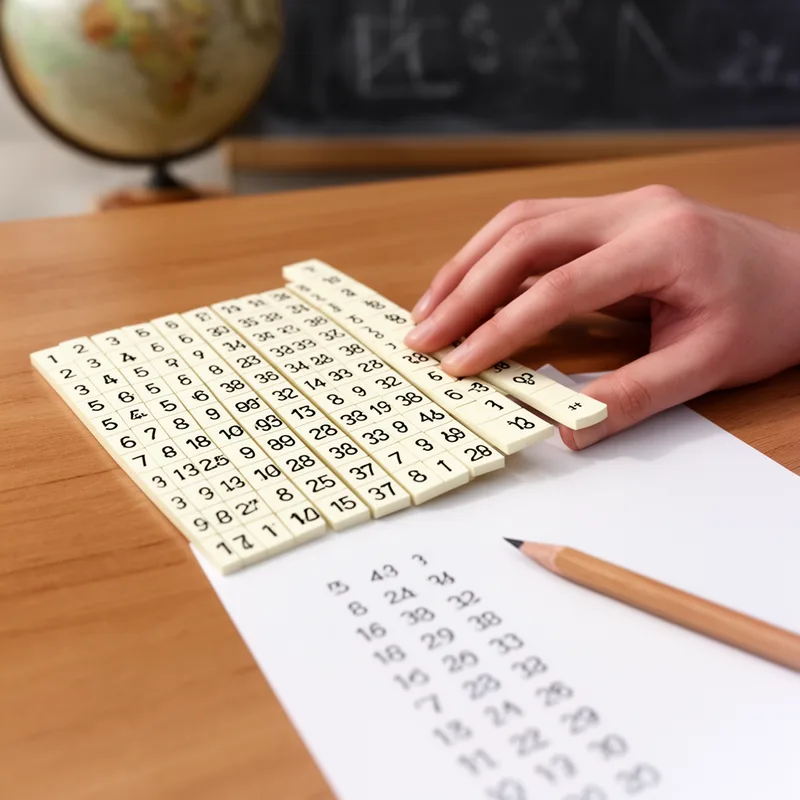
Napier's rods
- noun
- /ˈneɪpiərz rɒdz/
- Archaic
- Before the widespread use of calculators, mathematicians often relied on Napier's rods to simplify complex multiplications.
Examples
-
A set of Napier's rods can demonstrate how multiplication algorithms were performed in the 17th century.
-
John showed his students how to calculate square roots with Napier's rods during the math history class.
-
Using Napier's rods made calculations much easier.
-
Have you ever seen Napier's rods in action?
-
Before calculators were common, students learned multiplication with Napier's rods in math class.
-
In the 17th century, merchants used Napier's rods to quickly calculate prices and costs.
-
Teachers often used Napier's rods as a visual tool to help students understand multiplication.
Synonyms
 5
8.5

A long thin tool with sliding scales that people use to do quick math before calculators


 1
9.9
A Japanese abacus for doing simple arithmetic with beads
 1
9.9
A set of numbered rods used before calculators to help multiply and divide numbers
 1
9.0
A book of tables that helps you calculate and convert numbers

A very small handheld electronic device for doing simple math
Surface Forms
Morphology
Napier's + rod
The form is compositionally literal: a B1 learner who knows 'rod' and understands possessive 'Napier's' can infer these are rods associated with someone named Napier. However, the specific historical/technical function (a set of numbered rods used for multiplication and division) is specialized and not predictable from the constituents unless the learner knows the inventor, so the expression is only partially transparent.
Etymology
Napier's rods is named after the Scottish mathematician John Napier, who made a set of numbered wooden sticks called rods to help with calculations. By lining the rods side by side you can read numbers in rows to do 'multiplication' and 'division', so the name reminds us of a simple 'manual calculator'.