
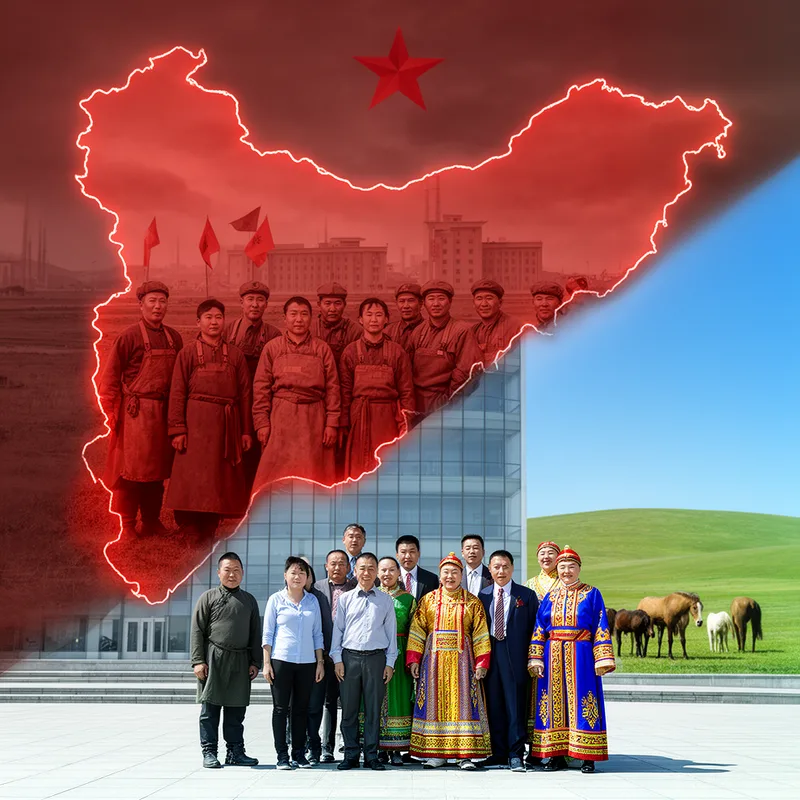
Mongolian People's Republic
- proper noun
- In 1924, the socialist MPR (Mongolian People's Republic) was officially established, and the capital city of Urga was renamed Ulan Bator (Red Hero).
Examples
-
The Mongolian People's Republic was officially founded in 1924 as a socialist state in central Asia.
-
In February 1950, Mao Zedong and the PRC leadership recognized the independence of Mongolia from China and began to establish state relations with the Mongolian People's Republic, as it was then called.
Academic text (2001) -
The relationship between Taiwan and the PRC since 1950 is akin to that between the Mongolian People's Republic and China from 1921 to about 1958, when China still asked periodically for the return of Mongolia.
Academic text (2001) -
During its existence, the Mongolian People's Republic maintained close ties with the Soviet Union.
-
The name Mongolian People's Republic was used until the country transitioned to a democratic government in 1992.
Surface Forms
Morphology
Mongolian + People's + republic
The meaning is directly compositional: 'Mongolian' (relating to Mongolia) + 'People's' (belonging to the people) + 'republic' (a state governed by representatives) yields 'a republic of the Mongolian people'. This naming pattern (e.g. 'People's Republic of China') is cross-linguistically common, so a B1 learner who knows the constituents will readily infer it refers to a political state, even if they might not know the historical dates or socialist context.
Etymology
Mongolian People's Republic comes from three parts: Mongolian, meaning the country; People's, meaning it said it was for the people; and Republic, meaning a country with its own government. It was Mongolia's official name from 1924 to 1992 when it had a government like the Soviet Union, so the name now refers to the country's former 'socialist' era.

