
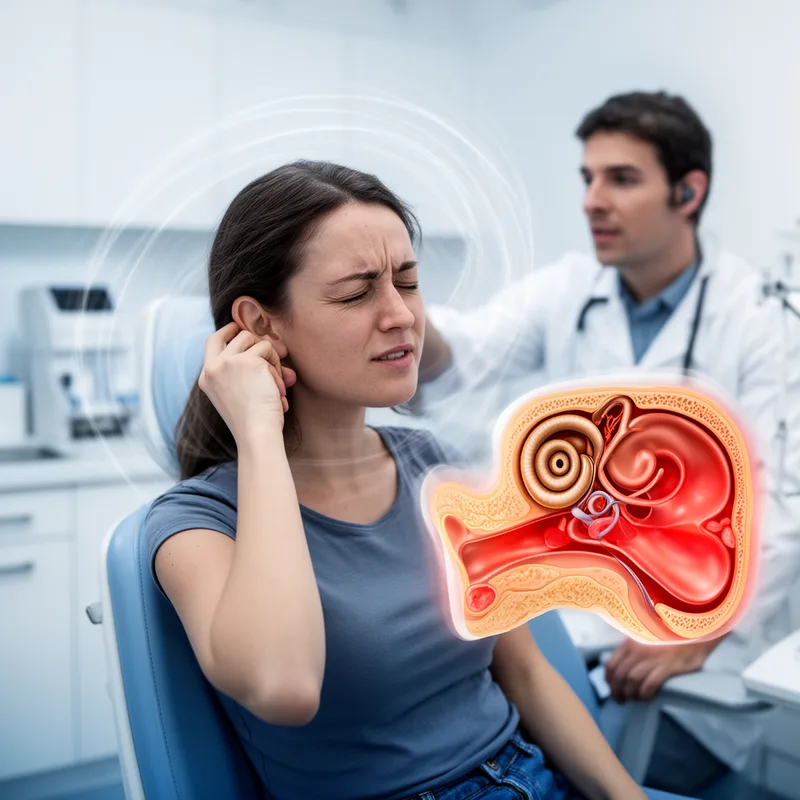
Meniere's disease
 1
5.3
1
5.3

- noun
- /məˈnɪrz dɪˈziːz/
- Specialized
- Recent findings indicate that many patients with Meniere's disease have anti-sulfated glucuronyl glycolipid (SGGL) serum antibodies.
- Meniere's disease patients
- symptoms of Meniere's disease
- treatment of Meniere's disease
Examples
-
The presumptive diagnosis after evaluation in a local urgent care department was Meniere's disease.
Academic text (2004) -
Only patients with symptoms of unilateral Meniere's disease at the time of initial examination were included.
Academic text (1995) -
Also, the natural fluctuations in hearing that accompany Meniere's disease must be considered.
Academic text (2008) -
The value of the E-S Shunt operation performed early in the course of Meniere's disease will be documented.
Academic text (1995) -
One of the methods used to treat Meniere's disease is the transtympanic perfusion.
Academic text (2001) -
Complete examination resulted in a diagnosis of Meniere's disease of allergic etiology.
Academic text (1995) -
Isolated episodes of vertigo and exacerbations of preexisting Meniere's disease are common during pregnancy.
Academic text (2003) -
The vertigo of Meniere's disease is typically treated with a low-salt diet, diuretics, and labyrinthine suppressants.
Academic text (2008) -
Patients experiencing vertigo may be diagnosed with Meniere's disease, which often affects just one ear.
-
Tinnitus is a common symptom associated with Meniere's disease, along with hearing loss and dizziness.
Surface Forms
Morphology
Meniere's + disease
This is an eponymic medical term: 'Meniere's' is a proper name with no descriptive lexical meaning, while 'disease' only indicates a health condition. A learner who knows the constituents would only infer that it is some kind of illness but could not derive the specific inner-ear symptoms (vertigo, tinnitus, hearing loss) from the parts alone.
Etymology
Meniere's disease is named after a French doctor, Prosper Ménière, who in the 1800s noticed that some patients had sudden 'dizziness', 'ringing in the ear', and slowly worse hearing because of a problem in the 'inner ear'. That's why the condition today still carries the doctor's name.