
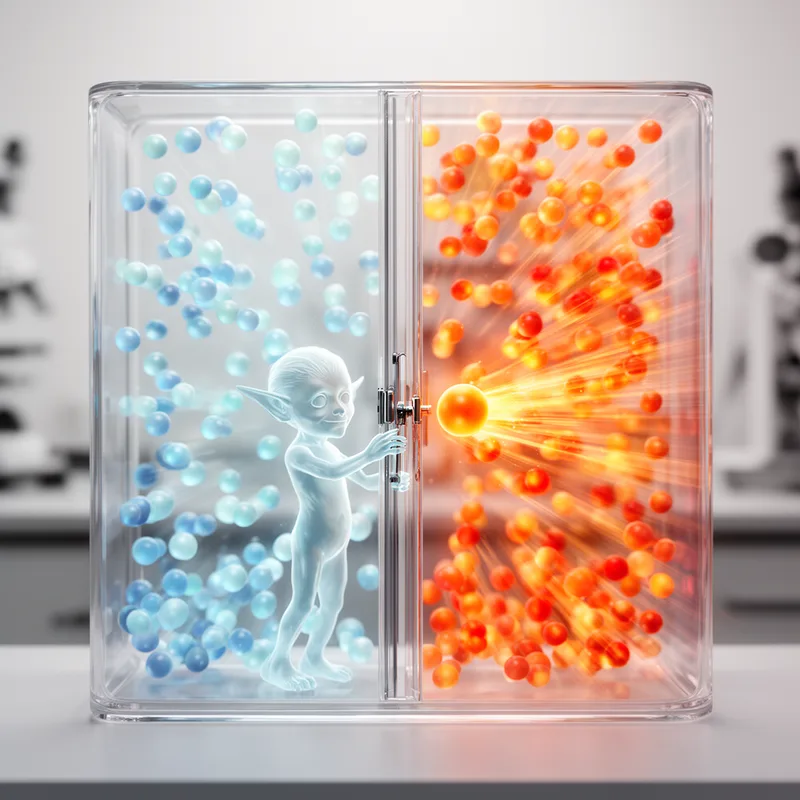
Maxwell's demon
- noun
- /ˈmækswɛlz ˈdimən/
- Specialized
- In physics class, we discussed Maxwell's demon and its implications.
Examples
-
One of the most famous thought experiments in thermodynamics involves Maxwell's demon.
-
Physicists debate whether Maxwell's demon could truly violate the second law of thermodynamics in practice.
-
The concept of Maxwell's demon highlights the relationship between information and entropy.
-
Have you ever heard of Maxwell's demon?
-
In the classic thought experiment, Maxwell's demon hypothetically allows fast molecules to pass through a partition, creating a temperature difference.
-
Maxwell's demon illustrates the challenges to the second law of thermodynamics by seeming to create order from chaos through selective molecule passage.
-
Physicists often reference Maxwell's demon when discussing concepts of entropy and energy transfer in thermodynamic systems.
Surface Forms
Morphology
Maxwell's + demon
This is an eponymous technical term named after the physicist James Clerk Maxwell; a B1 learner who knows 'Maxwell's' as a name and 'demon' as a supernatural being will not be able to infer the specialized physics meaning about measurement, feedback, and entropy. The sense is domain-specific and metaphorical in a technical way, requiring prior scientific knowledge, so it is not derivable from its parts.
Etymology
Maxwell's demon comes from a famous 'thought experiment' by the scientist James Clerk Maxwell. In the story a tiny demon stands at a small door between two gas chambers and lets fast molecules go one way and slow ones the other, making one side hot and the other cold so it seemed to 'break' the rule that heat spreads from hot to cold, and today Maxwell's demon means an imagined creature or idea that looks like it can make a physical law fail.

