

Lord's Supper
 2
7.7
2
7.7

- noun
- /lɔrdz ˈsʌpər/
- Every Sunday, the congregation gathers to participate in the Lord's Supper as a way to remember Jesus' sacrifice.
- gathering for the Lord's Supper
- receive the Lord's Supper
- offered in the Lord's Supper
Examples
-
I suppose that, on the surface, this seems to contradict the whole idea behind the Lord's Supper.
Blog text (16) -
Administration of the Lord's Supper by chaplains was, however, a controversial issue for several denominations.
Academic text (1991) -
And indeed, he says before that those who will use the Lord's Supper should use both.
Blog text (30) -
Christ even did at the Lord's Supper as well as on the cross.
Blog text (23) -
First, Paul held that the Lord's Supper was the "worst time to have divisions surface" in the Church.
Academic text (2002) -
Then consider taking the Lord's Supper after you have cleansed yourself.
Blog text (29) -
For the Gentiles are united in the Lord's Supper to the body of the Jewish Jesus.
Academic text (2000) -
Protestants celebrate Eucharist or the Lord's Supper, but it is not the same as the Catholic Mass.
Blog text (13) -
Four days later, he appeared in Suffield, having previously received an invitation to celebrate the Lord's Supper in the pastorless church.
Academic text (2005) -
The question goes unasked whether it matters that the body offered in the Lord's Supper is a Jewish body or that the practice enacted is a Jewish practice.
Academic text (2000)
Synonyms
 17
9.3
17
9.3
A Christian service when people bless and eat bread and drink wine to remember Jesus' Last Supper
 9
4.9
9
4.9
A Christian ceremony where people share bread and wine to remember Jesus
 8
6.3
8
6.3
A Christian ceremony when people eat bread and drink wine to remember the Last Supper
 4
9.1
4
9.1
A Christian ceremony that blesses bread and wine to remember the Last Supper
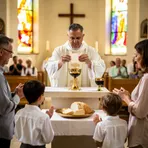 1
8.1
1
8.1
A Christian ceremony when people bless and eat bread and wine to remember Jesus' Last Supper
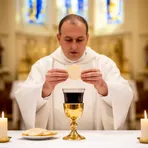

 1
9.8
1
9.8
A religious ceremony where Christians bless bread and wine to remember Jesus' Last Supper
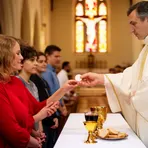
A Christian ceremony where people eat bread and drink wine to remember Jesus' death and his rising from the dead

A Christian ceremony where bread and wine are blessed and eaten to remember Jesus' Last Supper
Surface Forms
Morphology
Lord's + Supper
The components 'Lord's' (of the Lord) and 'supper' (an evening meal) make it reasonably clear to learners that this refers to a meal associated with the Lord, so a basic inferential sense is available from the parts. However, the technical sacramental meaning (the Christian ritual of Eucharist/Communion involving bread and wine in remembrance of Jesus) is culturally and religiously specific and not fully predictable from the literal constituents, so full understanding usually requires prior cultural or religious knowledge.
Etymology
Lord's Supper comes from the last meal Jesus had with his followers, when he shared bread and wine and asked them to 'remember' him. That's why the phrase means the church ceremony of sharing bread and wine to 'remember' Jesus.