
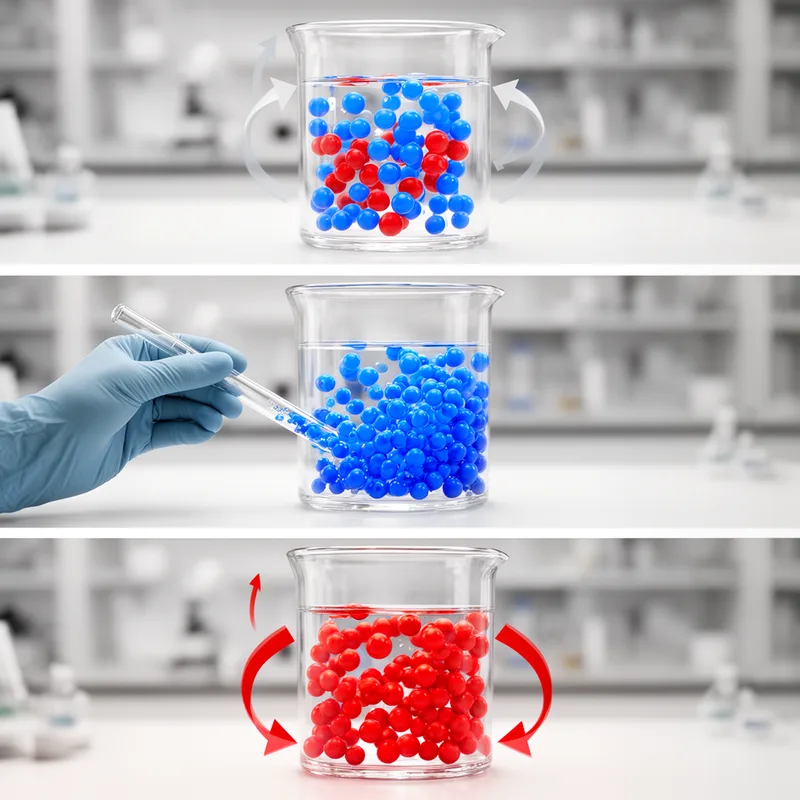
Le Chatelier's law
- noun
- /lə ˈʃætəˌljeɪrz lɔ/
- Specialized
- According to Le Chatelier's law, increasing the temperature will shift the equilibrium to favor the endothermic reaction.
Examples
-
According to Le Chatelier's law, increasing the pressure on the system will shift the equilibrium to favor the side with fewer gas molecules.
-
In industrial chemistry, Le Chatelier's law helps engineers maximize product yield by adjusting reaction conditions.
-
Students often use Le Chatelier's law to predict the effects of adding more reactants to a system.
-
According to Le Chatelier's law, the system will shift to counteract changes.
-
Have you studied Le Chatelier's law in your chemistry class?
-
In industrial chemistry, Le Chatelier's law is applied to optimize the reaction conditions and increase the yield of desired products.
-
Students frequently apply Le Chatelier's law to analyze how a change in temperature affects the position of equilibrium in chemical reactions.
Synonyms

A chemistry rule saying a balanced reaction changes to oppose a change and reach a new balance

A rule saying a balanced system moves to reduce a change and reach a new balance

A rule that says a balanced chemical system shifts to undo a change and move back toward balance
Surface Forms
Morphology
Le + Chatelier's + law
This is an eponymous scientific term: 'Le Chatelier's' is a proper name and 'law' only signals a rule or principle. A B1 learner who knows the words would know it's a named law but could not derive the specific equilibrium-shifting principle from the constituents, so the meaning is not predictable.
Etymology
Le Chatelier's law is named after a French chemist, but the easiest image is a simple balance: if you push one side, the balance moves to push back. So when a chemical system is changed by temperature, pressure, or the amount of substances, it 'pushes back' by shifting in a way that partly cancels the change, which is why the law helps predict how reactions will move.

